Luxor: Egypt’s Ancient Treasure Trove
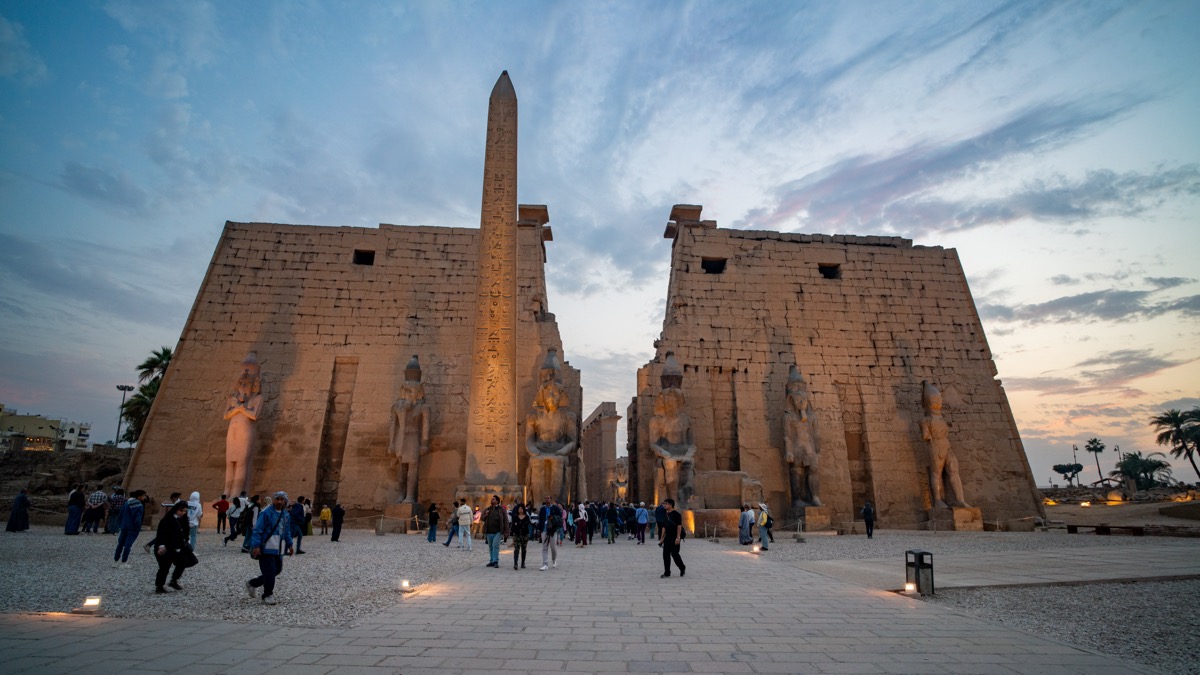
Our second destination after Cairo, which I wrote about here, was the city of Luxor. If there’s one city in Egypt that every traveler must visit, it’s Luxor. Home to some of Egypt’s most spectacular ancient temples and tombs, it offers incredible historical sites that transport you back in time. We spent five full days here, which turned out to be the perfect amount of time.
A Brief History of Luxor
I have written extensively about the history of Egypt in two blog posts here and here, but Luxor requires a dedicated introduction.
Once known as Thebes, Luxor was the capital of ancient Egypt during the New Kingdom (1550–1070 BCE), a period marked by military expansion, monumental construction, and the rule of some of Egypt’s most famous pharaohs, including Amenhotep III, Hatshepsut, and Ramses II. It was the heart of political, cultural, and religious life, dedicated to Amun-Ra, the supreme god of the time. The city played a central role in grand festivals like the Opet Festival, where statues of the gods were paraded between temples in a lavish spectacle.
Luxor is uniquely divided by the Nile, with its two banks serving distinct symbolic purposes. The east bank, associated with life and rebirth, housed the vibrant city center, massive temple complexes, and bustling markets. The Temples of Karnak and Luxor, among the largest and most impressive religious structures ever built, were dedicated to the Theban Triad of gods—Amun, Mut, and Khonsu. These temples were expanded over centuries by successive pharaohs, making them an evolving record of Egypt’s history.
In contrast, the west bank was associated with death and the afterlife. It served as a vast necropolis for royals and nobles, featuring the legendary Valley of the Kings, where pharaohs such as Tutankhamun and Seti I were buried in elaborately decorated tombs filled with treasures for the afterlife. Nearby, the Mortuary Temple of Hatshepsut stands as a masterpiece of ancient architecture, built against towering cliffs in Deir el-Bahari.
Even after Thebes lost its status as Egypt’s political capital, it remained a major religious center for centuries, thriving through the Ptolemaic and Roman periods. Today, Luxor is often called the “world’s greatest open-air museum,” offering visitors an unparalleled glimpse into one of history’s most powerful civilizations. Its monuments, hieroglyph-covered walls, and ancient tombs continue to reveal new discoveries, keeping the legacy of ancient Egypt alive.
The Night Train from Cairo to Luxor
While planning our trip, we considered flying from Cairo to Luxor, as my Egyptian friend strongly advised against taking the night train. The cost for tourists is almost the same, but we love overnight trains. They offer private cabins, save on hotel costs, maximize sightseeing time, and are a more eco-friendly choice—so it felt like a win. I did my research on how the train conditions are, and it seemed okay, so opted to take the train.
Booking the Tickets
I booked our tickets in advance through abelatrains.com, which, as of early 2025, is the only site where non-Egyptians can buy night train tickets. The website wasn’t the most user-friendly, and I had some payment issues, but after a bit of persistence, I managed to secure them.
Confusion About the Departure Station
Shortly after booking, I noticed something odd: the ticket listed “Upper Egypt” as the departure station, a place that doesn’t exist on Google Maps. Even my friend in Cairo did not know about it!
To make things more confusing, Cairo is located in “Lower Egypt,” so the name made no sense. Most YouTube videos showed Ramses Station as the departure point, but that’s not called “Upper Egypt Station”. So after some digging, we decided to board from El Giza Station (the second stop), which was easier to reach from our hotel anyways.
Arriving at El Giza Station
We arrived an hour before departure. The station staff told us the train would leave from platform 1. However, after passing security, we found ourselves on platforms 3 and 4—with no tunnel or overpass to reach platforms 1 and 2.
A “tourist cop” assured us we were in the right place, though he asked us to go inside a cafeteria on the platform, which was obviously a way for him to get a commision. So we were not sure if he really gave us the right information. Lack of electronic boards and Arabic-only announcements made it tricky for us to figure out on our own what platform we should be on. Eventually, after observing the direction of moving trains (i.e. which trains go north/south) and asking a local traveler, we confirmed we were indeed in the correct spot.
The Cabin Experience
The cabins were designed for two people, with bunk beds. If you book four seats, the two cabins can connect via an internal door. We had booked four but weren’t assigned connecting ones. Fortunately, the train attendant helped us swap one, then later brought us tea after dinner.
Tipping is expected, so I gave him 50 EGP for his help. However, he then informed us that the tea cost an additional 50 EGP and that we’d need to tip him $4 in the morning! His request felt a bit direct, but I handed him 100 EGP the next day and hoped that would do.
The Train Ride Itself
The ride was loud and bumpy, but we surprisingly slept well. I’m sensitive to noise when falling asleep, but silicone earplugs worked wonders—far better than foam ones.
The train wasn’t the cleanest, but at least the sheets were fresh, making it tolerable for one night.
The Return Journey: Not as Pleasant
The ride back to Cairo was mostly the same, except we had an issue with the A/C—it was freezing and couldn’t be adjusted. The train attendant said it would be fixed soon, but it never did. We spent the night shivering under the provided (and not-so-clean) blankets, barely sleeping.
Would I Recommend It?
If not for the return trip, I would have fully recommended taking the night train. But now? I’m torn. Having also experienced Cairo Airport (more on that later), I honestly don’t know which is the lesser evil. Pick your poison!
Our Time in Luxor
As I said before, we spent 5 full days in Luxor, thanks to arriving in the morning, and leaving in the late evening by train. We stayed at Sonesta St. George hotel, which I highly recommend. We moved around with inDrive mostly, and paid in cash.
Luxor is a much smaller and more quite city than Cairo, and arriving there, we felt immediately at ease being out of Cairo’s congestion.
Exploring Luxor’s Ancient Sites
Luxor is an incredible city, split by the Nile into two distinct worlds. The East Bank, the “land of the living,” houses temples dedicated to the gods. The West Bank, the “land of the dead,” is home to tombs and mortuary temples meant to guide pharaohs into the afterlife.
We visited nearly all the major sites (except Dendera Temple) using inDrive, which is much more common here than Uber. It was the cheapest and most flexible way to get around. We only struggled once, trying to find a ride from Medinat Habu to Deir el-Medina—otherwise, it worked smoothly.
Pro tip: Wear sturdy shoes! You’ll be trekking across lots of dirt, sand and uneven terrain. We also visited most sites in the late afternoon to avoid the crowds, as many Luxor sites get packed with tourists between 9 AM and noon.
Karnak Temple Complex
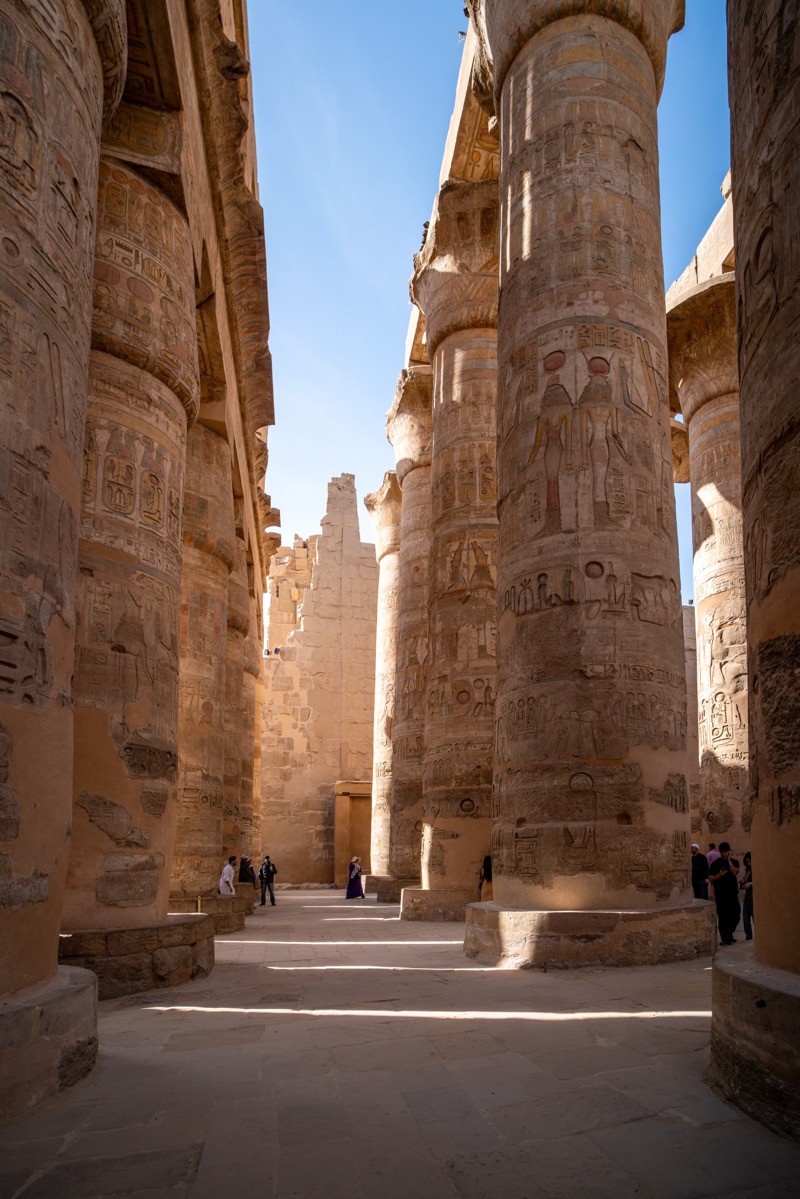
Karnak is a massive temple complex, built and expanded over 2,000 years. Every New Kingdom pharaoh contributed to it, each trying to outdo the last, making it the largest religious building ever constructed.
I was in awe of the Hypostyle Hall—its towering columns are overwhelming in scale. The whole place feels like a maze, with its many additions over centuries creating an almost chaotic layout.
Nearby, the Temple of Khonsu is worth a visit, as is the Avenue of Sphinxes, a 3 km-long road lined with sphinx statues connecting Karnak to Luxor Temple.
Luxor Temple
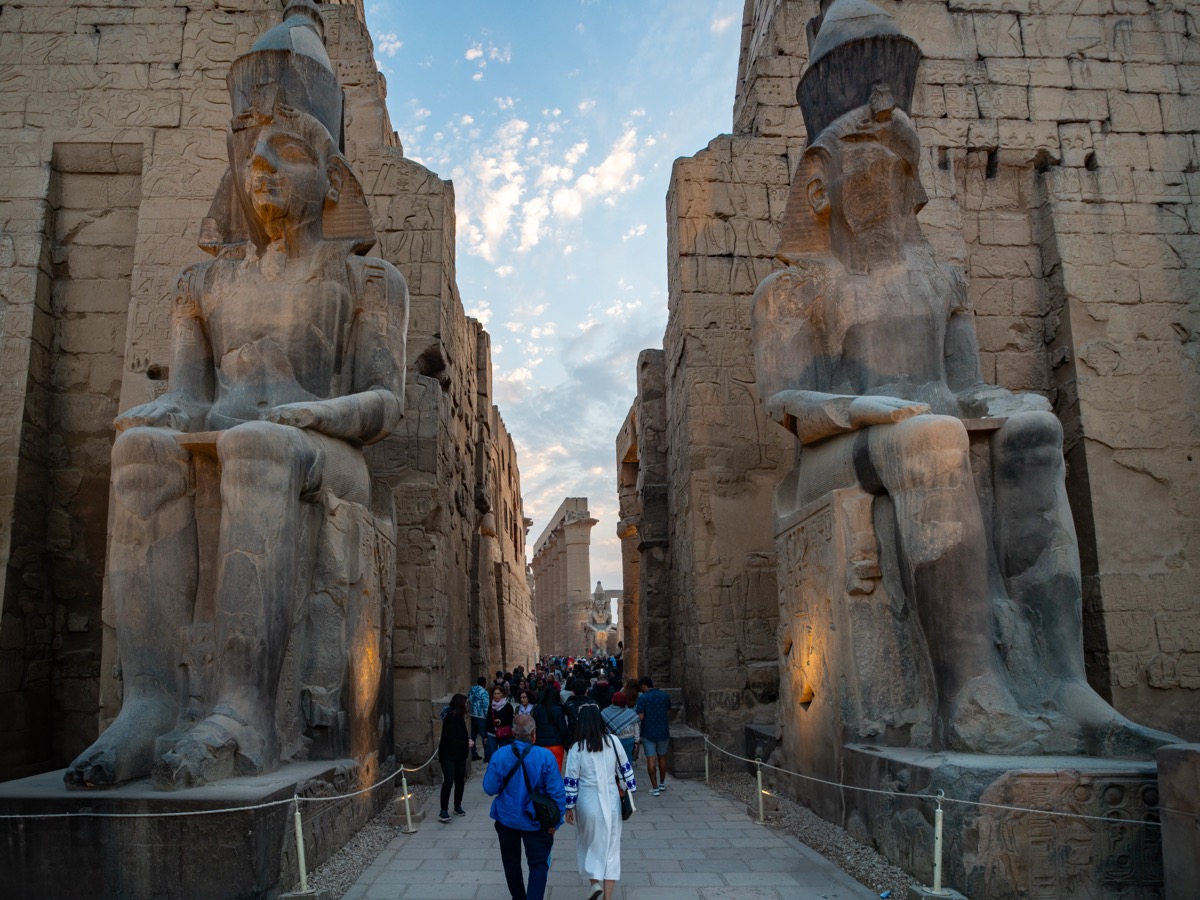
Unlike most temples dedicated to gods or pharaohs, Luxor Temple was primarily for the rejuvenation of kingship. Many pharaohs were likely crowned here, even those who ruled far from Thebes.
Built mainly by Amenhotep III and Ramses II, it’s best visited in the evening when it’s beautifully illuminated. The massive Ramses II statues at the entrance were my favorite part. Inside, there’s even a mosque—evidence of how religious sites change over time but retain their purpose.
Hatshepsut’s Mortuary Temple
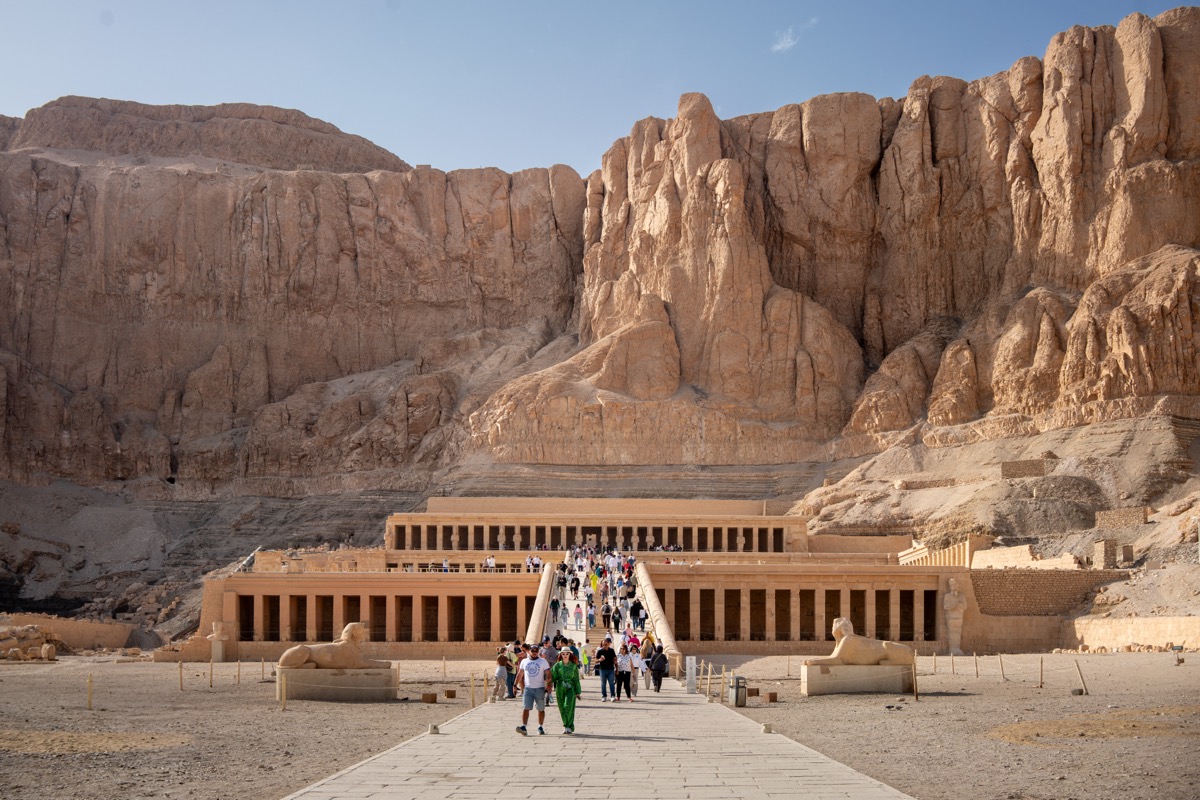
Built into the cliffs of Deir el-Bahari, Hatshepsut’s temple is one of the most stunning in Egypt. Hatshepsut ruled for 22 years (1479-1458 BCE), presenting herself as a legitimate pharaoh—often depicted with a false beard.
Her temple’s elegant terraces and colonnades blend seamlessly with the cliffs, making it a masterpiece of ancient Egyptian architecture.
Valley of the Kings
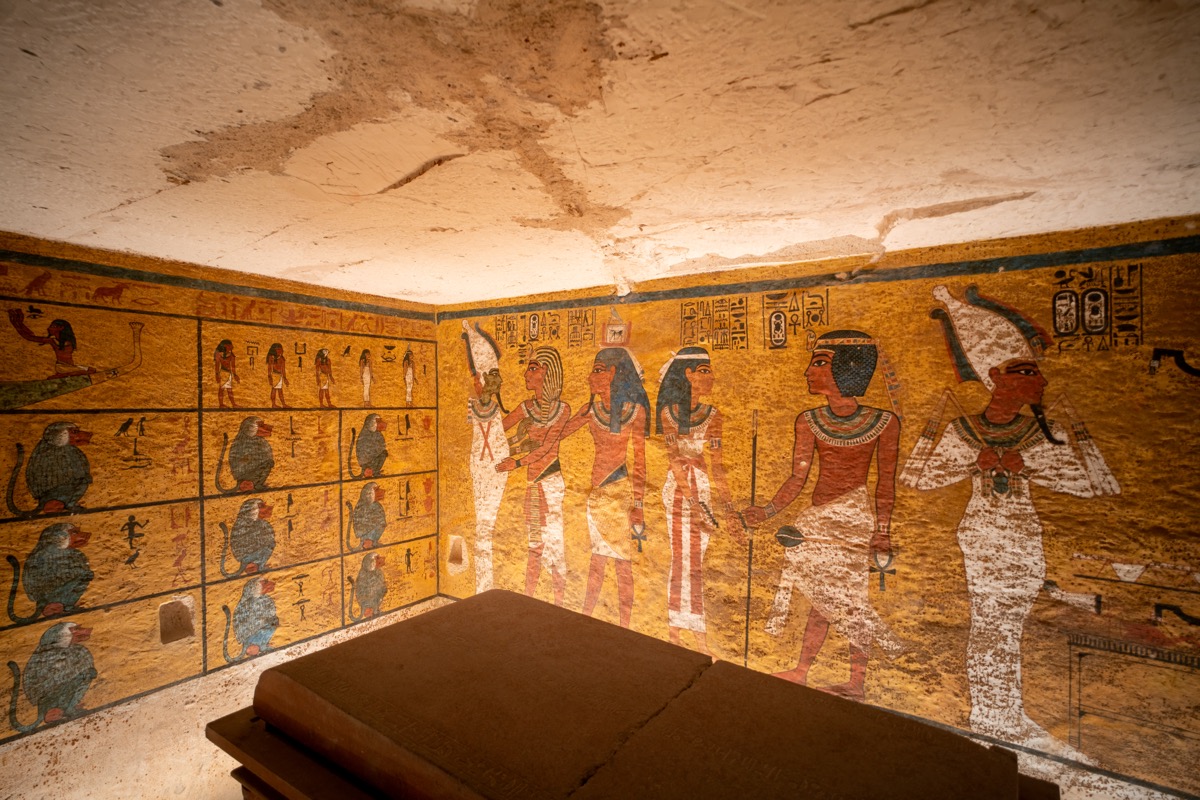
The Valley of the Kings served as the royal necropolis for Egypt’s New Kingdom pharaohs for nearly 500 years. Hidden in a secluded valley on the west bank of the Nile, this burial ground was chosen for its isolation and security. The tombs, cut deep into the mountainside, were elaborately decorated with religious texts and scenes from Egyptian mythology to guide the pharaohs in their journey through the afterlife. Unlike the conspicuous pyramids of earlier dynasties, these underground tombs were an attempt to prevent grave robbery—though nearly all were eventually plundered in antiquity. The discovery of Tutankhamun’s nearly intact tomb by Howard Carter in 1922 provided an extraordinary glimpse into the opulence of royal burials.
Valley of the Kings is one of the most popular attractions in Luxor, so we decided to go there late to beat the crowds. You can technically visit 3 out of all tombs per ticket (we visited more), except for certain tombs like Tutankhamun, Seti I, and Ramses IV/V that are extra. Seti I is supposed to be the most beautiful one, but it is also pretty expensive, so we decided to instead visit Tut and Ramses IV/V. They were both well worth the extra cost. We also liked the tomb of Ramses III, which had amazing paintings and carvings in a good shape. Fun fact: Tutankhamun is the only mummy that is still buried in his own tomb (that we know of). It had the smallest tomb out of all the tombs we visited, but it contained so much gold and precious objects that makes you think what other much larger tombs must have contained before being robbed!
Medinat Habu
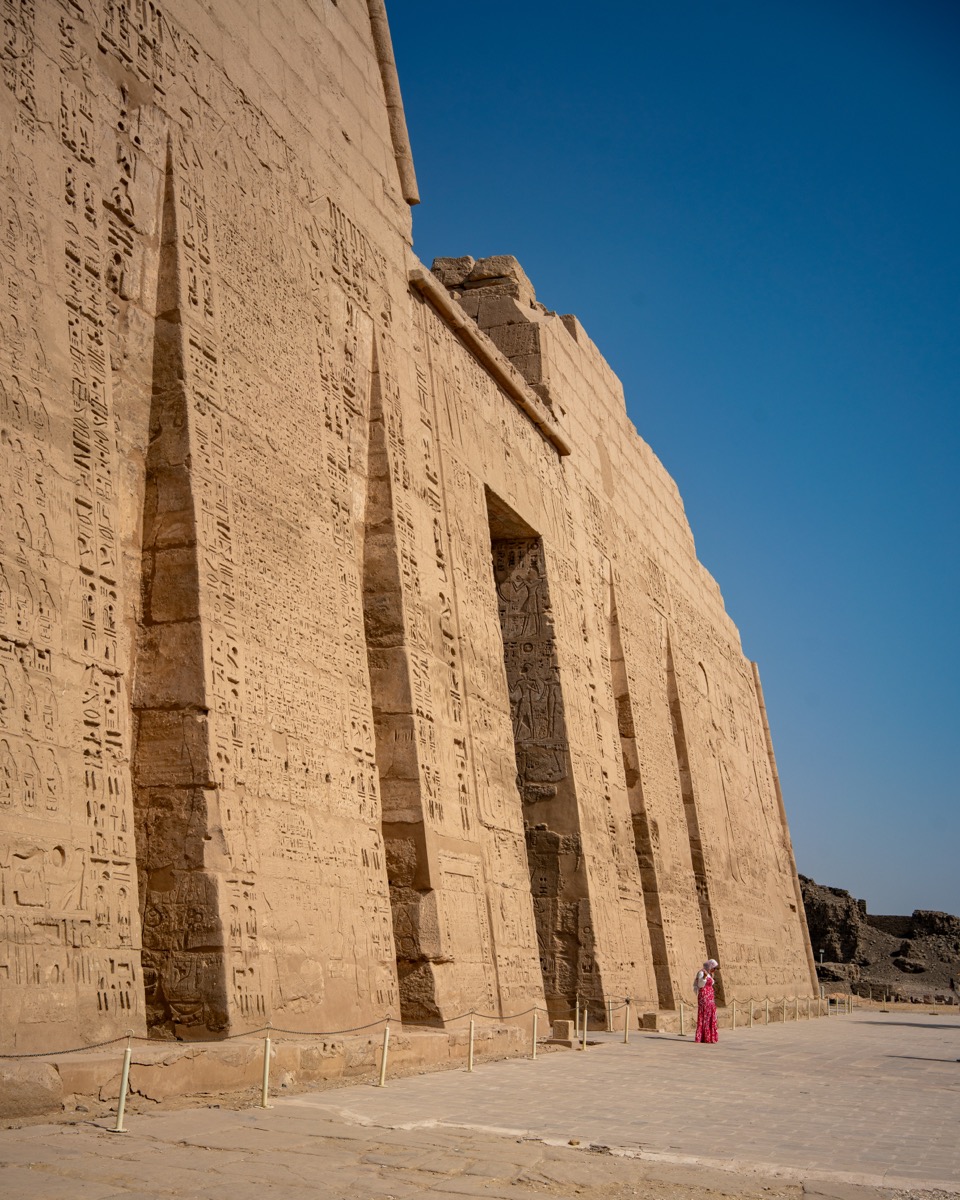
Medinat Habu is the mortuary temple of Ramses III, one of Egypt’s last great pharaohs of the New Kingdom. This massive complex, covering over 7,000 square meters, is surrounded by a fortified enclosure wall, making it resemble a fortress as much as a temple. Built during the early 12th century BCE, it is renowned for its well-preserved reliefs that provide valuable insights into ancient Egyptian warfare, religious practices, and daily life. The temple’s entrance, modeled after a Syrian fortress, features a unique architectural element known as a migdol, or fortified gateway, reflecting the foreign influences that had begun to permeate Egyptian architecture during this period.
We later visited Ramses III’s tomb in the Valley of the Kings. This is a must-visit temple on the west side of Luxor. Ramses III lived around 1200 BC and ruled for 32 years. He was a warrior king and repelled the attack from “sea people,” depicting his victories on the walls of his mortuary temple. He was assassinated in a “harem plot” involving one of his wives and her son, who were later put on trial by Ramses IV and condemned to death. We had seen the mummy of the patricidal son in the Egyptian Museum in Cairo.
Deir el-Medina
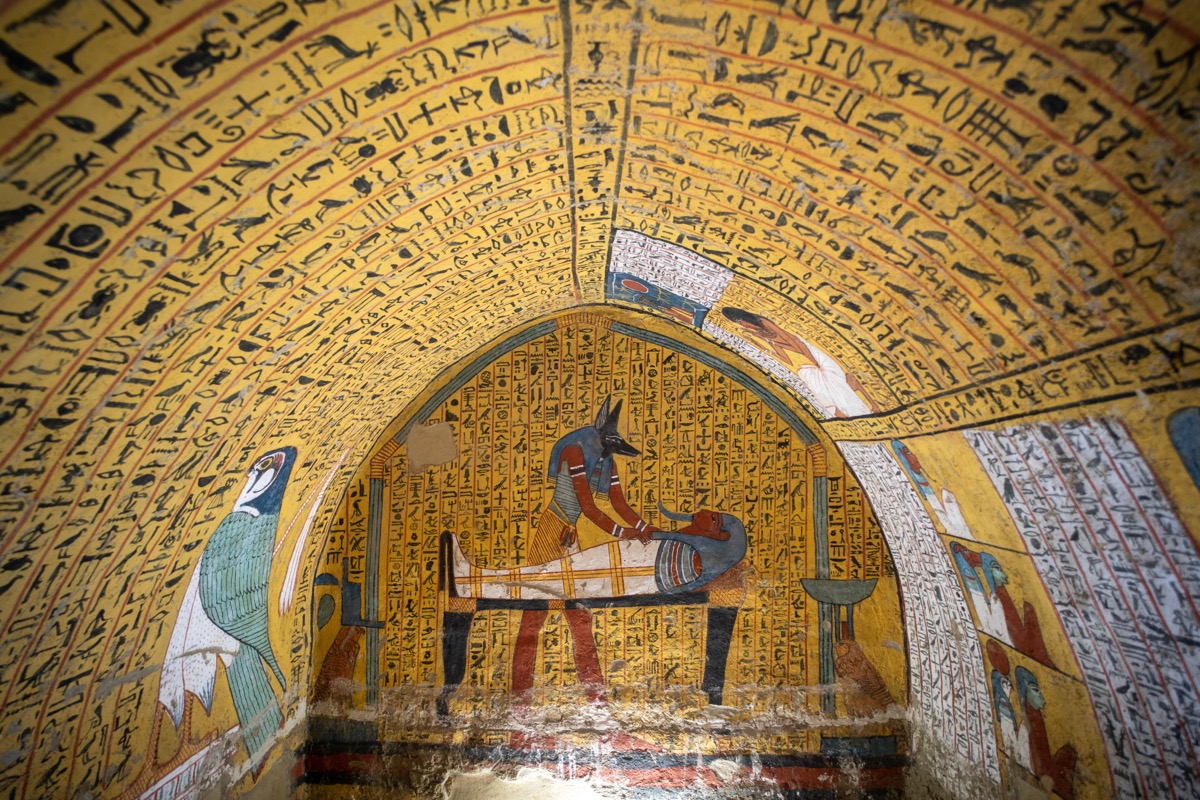
Deir el-Medina was the village of the artisans and craftsmen who built and decorated the royal tombs in the Valley of the Kings and Valley of the Queens. Unlike many archaeological sites that focus on temples and tombs of the elite, this well-preserved settlement offers a rare glimpse into the daily lives of ordinary skilled workers in ancient Egypt. Dating from around 1550-1080 BCE, the village housed generations of craftsmen and their families, who lived under strict supervision due to their knowledge of royal tomb locations and contents. Archaeological discoveries here, including thousands of ostraca (limestone flakes with writing), have provided unprecedented insights into everything from work schedules and payment disputes to family life and religious practices of ordinary Egyptians. There are small tombs that are amazingly painted, and it was worth a visit.
Dendera Temple of Hathor
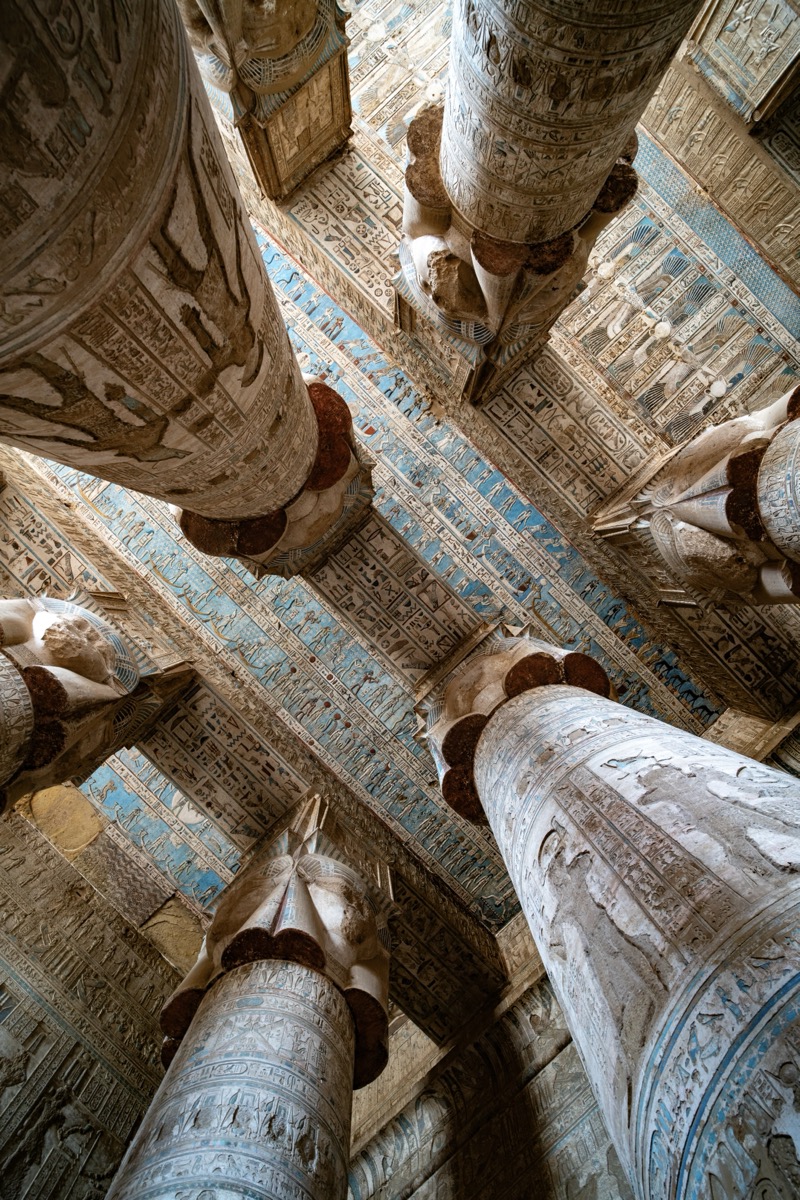
The Temple of Hathor at Dendera, located about 60 kilometers north of Luxor, is one of the best-preserved temple complexes in Egypt. Built during the late Ptolemaic period (primarily by Ptolemy XII and Cleopatra VII) and completed during Roman times, it represents a magnificent example of Greco-Roman Egyptian architecture. Dedicated to Hathor, the goddess of love, beauty, music, and motherhood, the temple features elaborate astronomical ceilings, crypts with mysterious reliefs, and the famous Dendera Zodiac (the original is now in the Louvre). What makes Dendera particularly special is its remarkably intact state, with its soaring hypostyle hall, underground passages, and roof chapels offering visitors an authentic experience of an ancient Egyptian temple complex.
We arranged a private tour with our hotel ($60 for all of us) to take us there and back. Watching the road along the way was pretty interesting, as you saw the everyday life of Egyptians living outside the larger cities. They certainly are pretty poor and live in low conditions.
The hypostyle hall of Dendera Temple is one of the most well-preserved temples, with vibrant blue colors and many stone carvings. Sadly, most of the face carvings were deliberately damaged by early Christians during the late Roman period. It was so frustrating to see so much damage. Their ancestors built these amazing pieces of art, and they took a chisel and hammer to them. Such a pity!
Flyout out of Cairo
Our Egyptian adventure concluded with a train journey back to Cairo, where we spent a final day exploring before our departure. While the trip was largely memorable, Cairo International Airport stood out as a challenging experience. The crowded terminals, chaotic atmosphere, and confusing layout made navigation difficult.
On our departure day, we received notice of a two-hour delay, which ultimately extended to four hours. Adding to the frustration, our gate assignment remained unknown until just 30 minutes before boarding. The airport’s unconventional security arrangement—with final screening conducted at the gate rather than after check-in—further complicated the process.
Due to these extensive delays, we arrived in Aqaba, Jordan much later than anticipated, cutting into our planned itinerary there.
FAQ
Why didn’t you take a Nile cruise instead of staying in Luxor?
This is a big topic on its own! I did a lot of research on this, but in the end, we decided against it. First of all - a disclaimer - I am not a big fan of cruises or organized tours, in general, for many reasons, and all applied in this case. I avoid cruises because:
- You lose your freedom to see and do whatever you want at the time with the duration you want. This is a big one for us.
- You are crammed into a small space with many other tourists, and you have to do queues for everything, food, facilities, visiting attractions, etc.
- Often the schedules are pretty packed, starting from very early in the morning to evening. This would not work with a small kid.
- You end up visiting the attractions with many other tourists at the same time, whereas if you travel alone, you can visit at less crowded periods of time.
- You typically end up paying a lot more than if you had organized it yourself.
- Cruise ships are the worst form of travel in terms of pollution. It is astonishing how bad they are for the environment.
- They keep the engines on at all times, which not only creates pollution but also noise, so staying in your cabin may not be very pleasant (depending on where your cabin is).
Nile cruises specifically were not appealing because they don’t actually “cruise” much. They spend most of the time docked at either Luxor or Aswan. Besides, they line up back to back and side to side, often making the passengers go through other cruises to even exit to land. This means that not only you get more pollution and noise, but also you don’t get a good view out of your room most of the times!
Of course, there are certain advantages to taking the Nile cruises, most importantly you visit all the major temples along the Nile between Luxor and Aswan, which we missed. But in the end, the cons far surpassed the pros, so we decided to do it on our own.