French Polynesia: The Promised Paradise!

The final stretch of our round-the-world adventure took us to French Polynesia, perfectly nestled between New Zealand and Seattle. French Polynesia, especially Bora Bora, had long been a top destination on our bucket list, making this a dream come true. It was a no-brainer decision since adding French Polynesia to our itinerary only cost us an extra $400 on our airfare from New Zealand to Seattle. Had we flown from Seattle directly, the round-trip tickets would have set us back $3000 or more. With this opportunity in hand, we couldn’t resist turning our dream into reality! It turned out to be the most spectacular finale to our epic journey around the globe.
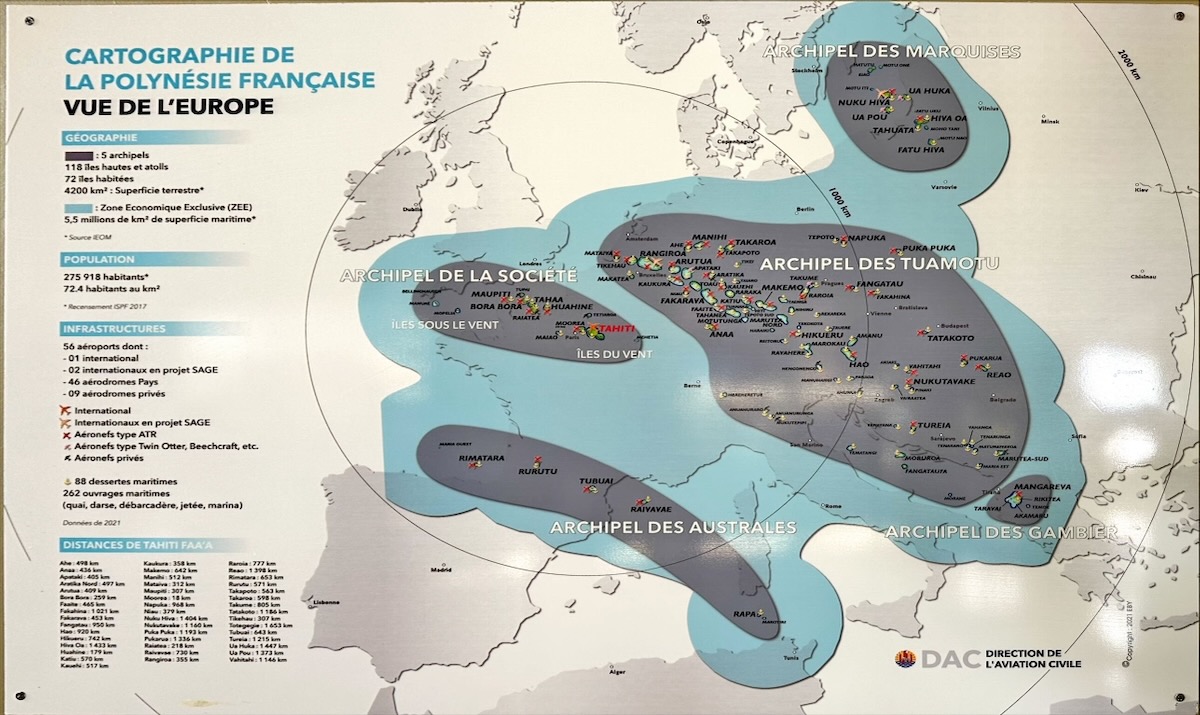
Superposition of FP islands on Europe, to show how large and spread-out the archipelago is.
Overview of French Polynesia
French Polynesia, an overseas territory of France, is an archipelago of more than 100 islands, sitting in the middle of the Pacific Ocean and covering a vast expanse almost the size of Europe. It comprises five archipelagos: the Society Islands, the Tuamotu Archipelago, the Gambier Islands, the Marquesas Islands, and the Austral Islands. The largest island, Tahiti, located within the Society Islands, is synonymous with French Polynesia, its people, and their language. The islands’ landscapes range from high, rugged, volcanic terrains with lush vegetation, like Tahiti, to low-lying coral atolls, like the Tuamotus, making French Polynesia a prime destination for tourism.
The iconic photos from French Polynesia always showcase the turquoise lagoons around the islands such as Bora Bora. These lagoons were formed through a combination of volcanic activity and coral reef development. Initially, these islands began as volcanic islands created by magma rising and erupting through the ocean floor. Over millions of years, the volcanic islands eroded and sank due to subsidence, a process where the Earth’s crust cools and contracts. As this happened, coral reefs grew around the islands’ edges in the warm, shallow waters, forming barrier reefs. As the islands continued to erode and sink, the central parts submerged, leaving the coral reefs as a ring around a shallow central lagoon. This process resulted in the stunning turquoise lagoons surrounded by coral reefs, with remaining central peaks often forming small islands or motus within the lagoons, creating the picturesque and biodiverse environments that Bora Bora and other French Polynesian islands are famous for today.
The islands were first settled by Polynesians around 1000 AD, with European explorers arriving in the 16th century. France established a protectorate over Tahiti and its dependencies in the 19th century, and in 1880, French Polynesia was annexed, becoming a French colony. Today, it enjoys the status of an overseas collectivity, with greater autonomy since 2003. The culture reflects a blend of ancient Polynesian traditions and French influences, seen in music, dance, tattooing, and cuisine, which includes both traditional Polynesian food and French culinary elements.
French is the official language, though Polynesian languages like Tahitian are widely spoken. The population, primarily Polynesian, includes European (mostly French), Chinese, and other Pacific Islander ancestries. Christianity is the predominant religion, with Protestantism and Roman Catholicism being the main denominations. The economy is driven by tourism, pearl farming, agriculture, and fishing, though it faces challenges such as geographic isolation and reliance on imports.
Tourism highlights include Bora Bora, known for its luxurious overwater bungalows and crystal-clear waters; Tahiti, the largest island and the cultural and political center; Moorea, famed for its dramatic landscapes; and Rangiroa, one of the world’s largest atolls, renowned for its diving opportunities.

Our Experience in French Polynesia
We spent around 2 and a half weeks there, visiting 4 islands. We arrived in Tahiti from New Zealand, stayed overnight, and then took the ferry to Moorea. We stayed 5 nights in Moorea, and then flew to Raiatea, where we spent another 5 nights. We then took a ferry to Bora Bora, where we spent 4 nights, and then flew back to Tahiti, and spent the last 2 nights of our trip there.
We did not stay in any luxury resort, as they are prohibitively expensive. We visited one to inquire about their Tahitian dance evening, walked around it, and it looked very nice, but we didn’t want to spend a fortune on accommodation and food, so we opted to stay in airbnbs at a fraction of the cost. Some people go there exclusively to enjoy the high-end luxury resorts with over-the-water bungalows and all, but we didn’t feel this is special enough to justify spending a fortune.

Tahiti
The island of Tahiti, the largest and most populated island in French Polynesia, is usually skipped by tourists, as it lacks turquoise lagoons, and most of its beaches are fine black sand, which looks nice in photos, but it’s not best for sunbathing and snorkeling. We did spent the first night and the last two nights of our trip there though. We had two full days, and we went around the island, visiting some waterfalls, black sand beaches, and botanical gardens. I think Tahiti can be an excellent place for hiking, since its interior has tall mountains and rainforests, but there are not that many marked trails. Overall, I think Tahiti can be skipped in a time crunch, as other islands have a lot more to offer.

Moorea
The island of Moorea is located near Tahiti, so the best way to get there is using a ferry, taking around 45 minutes. We took the ferry on a Sunday, and that meant that the earliest ferry after 8 AM was around 3 PM. The ferry itself was very large, and had a cafeteria onboard, which was nice.
Moorea is a beautiful island that has it all: amazing nature, beautiful beaches, and turquoise lagoons. Most importantly, it has two long public beaches - something that is common in many other islands - and you can snorkel right off the beach. Temae Beach was particularly pretty stunning, and had one of the best snorkeling experiences. There are many hiking trails in Moorea as well, but we chose a rather difficult one given we had a toddler along, and had to turn around. We spent 5 nights in Moorea, and we could have easily spent another few nights there. Overall, Moorea is a must-visit island in French Polynesia, and it offers a great value compared to Bora Bora, for example.

Raiatea
We decided to visit one of the more off-the-beaten-path islands as well, and Raiatea seems to be a great choice. We flew from Moorea to Raiatea, and both airports were tiny! There was literally one hall with a door for departure, and another for arrival. You would walk out of the departure door to the propeller plane, and that was it. We flew with Air Tahiti, and they do not assign seats, so we queued up pretty early to make sure we get good seats. That paid off very well, as we saw the amazing lagoons of Moorea and Raiatea from above, and I managed to take some good photos.
We were not so lucky with Raiatea’s weather, as it rained most of the time we were there. The island seems to be rainier than say Bora Bora - which is visible from there - due to its taller mountains. One big issue with Raiatea was that it didn’t have a public beach. Some of the small islets, aka motus, around it are public, so you can get there with a boat. We managed to visit Motu Ofetaro one day by a taxi boat, and had a great time there. Another thing we did was a day tour of the adjacent island of Taha’a, visiting a pearl farm, vanilla farm, and a rum distillery. We also did floating snorkeling in a coral garden there, which had the clearest water I’ve ever seen, with lively colorful corals and plenty of fish. It was a bit too short though, as our guide rushed us to the next stop in our itinerary. Overall, Raiatea wasn’t as satisfying due to excessive raining, and lack of public beaches.

Bora Bora
No visit to French Polynesia is complete without experiencing its most famous island, Bora Bora. I first heard about Bora Bora in the sitcom “Frasier,” where the titular character relaxes in the iconic over-the-water bungalows. Since then, Bora Bora has been at the top of my travel list. The island is renowned for its stunning aerial views, featuring a towering peak surrounded by a turquoise lagoon.
Given its proximity to Raiatea, we opted to take a ferry to reach this paradise. My expectations were high, but it’s safe to say that Bora Bora handily exceeded them. It’s easy to see how Disney’s “Moana” might have drawn inspiration from this stunning location. Bora Bora’s lagoon is just stunning with so many shades of blue—clear turquoise near the shores and deep azure further out—it’s like a tropical paradise painted in watercolors.
Sadly all the motus around Bora Bora are private, and most of the 5-star luxury resorts are located on them. We stayed on the main island, but we took two snorkeling tours to visit the lagoons, and had lunch on one of the motus with impeccable views. Another favorite activity for us was to visit Bora Bora’s Matira Beach, which has shallow light blue waters and a white sandy shore. We often saw stingrays and eagle rays close to the shore, which was amazing.

The snorkeling adventure in Bora Bora truly stood out as the highlight of our trip. We swam with sharks, manta rays, stingrays, schools of eagle rays, and among many colorful reef fish. We also explored two vibrant coral gardens filled with diverse fish and stunning corals. I am so happy to have had my DJI Osmo Action camera there to capture these experiences. While I’ve snorkeled in many places around the world, Bora Bora offered an unparalleled experience that exceeded all expectations.
In Bora Bora, we had to pinch ourselves to believe we weren’t dreaming, and we found ourselves repeatedly marveling at the realization that this truly was the promised paradise we had always imagined! French Polynesia is one of those rare places that makes you swoon long after you’ve left, pulling you back with the promise of more.
With this, our 9-month-long round-the-world trip came to an end, and we went back home. We explored 15 countries, cherished quality time with family, and marveled at some of the most breathtaking places on Earth. It was an unforgettable adventure filled with countless memories that I’m still processing! I will (hopefully) write a few more blog posts about this adventure, and share more insights about it in near future.
FAQ
How expensive is it to travel in French Polynesia?
French Polynesia is no doubt an expensive tourist destination due to its remote location, and the prevalence of luxury resorts, especially in well-known spots like Bora Bora. High-end accommodations, gourmet dining, and exclusive activities like private lagoon tours contribute to its reputation for being costly. However, it doesn’t have to be prohibitively expensive. In fact, in my experience, it is almost as expensive as Hawaii. Budget-conscious travelers can find more affordable options, such as family-run guesthouses (pensions) or airbnbs, local eateries, and (scarce) public transportation. Additionally, less touristy islands within the archipelago offer a more economical yet equally stunning experience, allowing visitors to enjoy the natural beauty and rich culture of French Polynesia without breaking the bank. There are two other main costs as well: 1) airfare to travel between the islands, though it can be cheaper, if you take a ferry, and 2) activities like snorkeling, 4WD or ATV tours, etc, can be pricey. However, I would not skimp on activities, otherwise there is not much to do in say Bora Bora, and you’ve already paid a lot to get there anyways.