Portugal: Algarve, Lisbon and Porto

After a day of delay due to the cancellation of our flight by EasyJet, we arrived in Faro in south of Portugal, aka Algarve. Algarve is a well-known holiday destination among Europeans looking for sun. For the first time ever, we decided to stay in an all-inclusive resort for a few days, and see why it’s so popular with parents. I can certainly see why now: You don’t have to cook, do groceries, look for and go to restaurants, etc, so there is a lot less hassle, and decision makings. There are also lots of family-friendly activities, and our son definitely enjoyed them. But I also realized if it is up to me, I would never want to stay in a resort! Don’t get me wrong, resorts are perfect “vacation” places, but are exactly the opposite of “travel” for me. We often use these two words interchangeably, but they are not necessarily the same. More and more I find my travel philosophy to be aligned with what Pico Iyer said in 2000 in his essay on travel:
“We travel, initially, to lose ourselves; and we travel, next, to find ourselves. We travel to open our hearts and eyes and learn more about the world than our newspapers will accommodate… And we travel, in essence, to become young fools again — to slow time down and get taken in, and fall in love once more. The beauty of this whole process was best described, perhaps, before people even took to frequent flying, by George Santayana in his lapidary essay, “The Philosophy of Travel.” We need sometimes,” the Harvard philosopher wrote, “to escape into open solitudes, into aimlessness, into the moral holiday of running some pure hazard, in order to sharpen the edge of life, to taste hardship, and to be compelled to work desperately for a moment at no matter what.”

As you can see, staying in a resort doesn’t align much with this philosophy. So as we wanted to experience the true Algarve, we decided to stay a few days in an airbnb in Faro old town, and go explore the surrounding area, and I’m happy we did so. Faro has a cute little old town that is a perfect place to slow down, and take walks. We also visited Tavira, which is even nicer, I would say. Algarve is also a great place to have seafood, and although I’m generally not a big fan, I really enjoy the way the Portuguese cook seafood.
One thing that I haven’t discussed much here is how much time and energy the whole trip planning takes. We had not planned the trip this far. When we started, we only had plans for the first few weeks, and some ideas for the first two months. But the rest of it was pretty much open-ended. So we had to go through many options, and consider many factors to decide what to do. It’s like solving a constrained optimization problem - with not so clear objectives. In our first week in Portugal, we spent a good few days deliberating on the rest of the trip, and we finally planned it through. Given that we are in the summer of “revenge travel”, it helps a lot to plan ahead for things like flight and accommodation reservations.
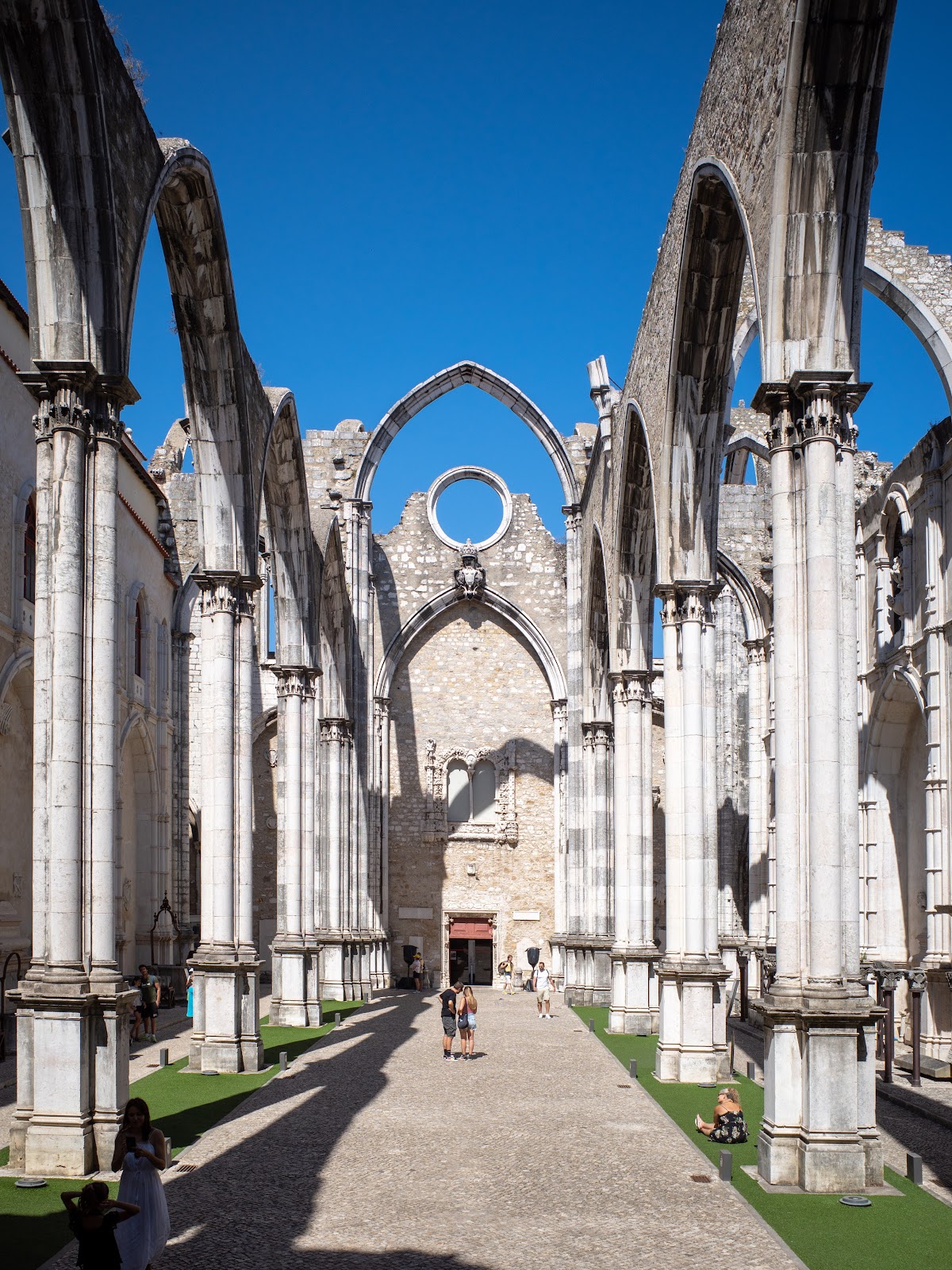
Our next destination was Lisbon which from Faro was 3h30, by direct train. Portugal has a comprehensive, and inexpensive train network that conveniently connects all the touristy places. Uber and taxies are also a cheap way to get around in the cities, or between smaller towns in Algarve, though Uber is not the most reliable, as sometimes they cancel the trip, or arrive late. Anyhow, public transportation is pretty convenient in Portugal, so you really don’t need to rent a car. We stayed in the Alfama neighborhood, which is this old hilly neighborhood with lots of character. It was a great place to visit, but not the easiest with a stroller, due to the steep cobblestone streets. During our stay, we visited the Jeronimos Monastery, which was a great delight. We also visited Pena Palace in Sintra, but that was a bit too crowded, and not ideal with a baby/stroller. You want to hike around to see the beautiful palace from a vantage point close by, but of course we could not.

One of the subjects I liked to shoot in Lisbon were the iconic trams scaling up and down Alfama. The photo on top of the page was a happy coincidence, and I really like how it turned out. But the photo above, was premeditated, and carefully planned. I found this composition that I really liked - with the towers of the cathedral in the backdrop, at golden hour with good light, and I positioned myself such that I can capture a light accent on the tram beaming out from a shop at the right moment - and waited for a tram to arrive. I waited and waited, but no tram came at all. Meanwhile my wife and baby were getting restless in a park nearby, so I called it off, with no photo to show for. The next day, however, I left them at home to relax, and came to the same spot, and waited again. This time I even got lucky, and got two trams crossing! Moral of the story: Don’t give up on your dream photo, but make sure your wife and kid are happy too. :)


Our last few days in Portugal were spent in Porto. We took a fast train from Lisbon to Porto, which again was quite convenient. Porto, much like Lisbon, was overcrowded with tourists. Case in point: There is a famous library in Porto called Livraria Lello, which has an stunning interior decoration, and it is said to be J.K. Rowling’s inspiration for Harry Potter, as she used to live in Porto for some time. The line to visit this library was over 50 meters long! We obviously didn’t even try to get in. But nevertheless, we went around, and mostly visited the city itself, which mind you, is gorgeous. A surprisingly stunning place we visited was Palacio da Bolsa, which used to be the stock exchange of Portugal up until recently, and now it is a place you can visit. The interior of the befittingly called “palace” is richly decorated - something you don’t necessarily expect from a stock exchange building. The highlight of the palace is visiting a hall called Arab Room - named due to its style - which was totally unexpected. It is a room you expect to see in an old middle-eastern palace belonging to a rich king. I highly recommend visiting Palacio da Bolsa to all photographers, as there are a lot of opportunities for architecture photography there.
On a side note, one thing that is rather frustrating in Europe is dealing with “Accept the Cookies” button on EVERY website you visit. We sporadically see that in the US, but thanks to GDPR, a European law to protect the data of its citizens, every website asks you whether you agree to share info with them. And of course, since they all want to store, use or sell that data, most websites make it ever slightly harder to reject the cookies than accepting them. A few have an option to reject the cookies on the prompt, but the majority make you go through a big list to opt out. Also, it’s not like they ask you once. Oh no. EVERY TIME you visit their websites, they ask you the same thing again. That gets annoying fast. It seems like that the EU lawmakers wanted to fix a problem, but created a hassle instead.
Our next destination is going to be the United Kingdom! Stay tuned for that! Per usual, here is a link to my instagram account:
https://www.instagram.com/photopensieve/
Follow me to see the latest photos of the trip. I’ll end the post with an FAQ.
FAQ
How family-friendly is Portugal?
Portugal is the most family-friendly country we’ve ever visited. Not only people are nice and caring when they see you with a baby (which for the most part all countries we have visited have been too), but also there are laws to prioritize parents of young children in pretty much any line, be it in the airport, grocery, transportation, etc. We enjoyed it so much that we don’t know how we are going to deal with going back to ALL other countries that don’t give such privileges to parents! We also found changing tables, and even dedicated changing rooms everywhere we went - we cannot say the same thing about any other country (I’m looking at you, Italy!)
Is July a good month to visit Europe?
Well, I used to think like that at least Northern Europe would be best in July and August. But two things make me rethink this: 1) Revenge travel after Covid, aka overcrowded everywhere you go, and 2) global warming that has resulted in unprecedented heat waves. Even Switzerland and UK are having 35+ or close to 40 degrees temperatures these past few years, and given that the accommodations and many public places and public transportations in these countries aren’t typically equipped with air conditioning means that you’re going to suffer during the heat waves, much more so than a traditionally hot place. We didn’t have these problems in late April, May and even into June. Moving on, I would think twice about visiting (most places in) Europe in July and August.