Puglia: Italy’s Underrated Treasure

Puglia is an agricultural powerhouse in Italy, producing 40% of olive oil of all Italy, just as an example. It is also one of the longest inhabited, and archeologically rich regions in Italy. However, it is comparably an understated and under-visited region located on the heel of Italy’s boot. Most (non-domestic) tourists stick with the triangle of Rome, Florence and Venice, and some of the more seasoned travelers even venture into the south, but sticking to Pompeii and Amalfi Coast. But few even know of the Puglia region, let alone visit it (I personally didn’t know much about it until 6 months ago). Puglia is well-known to the domestic tourists though, as they seek its regional cuisine, sun-soaked white washed small towns, and pristine beaches. And this is exactly why we went there as well.
We stayed 10 days in Puglia, breaking down our stays in two places: Martina Franca in Val d’Itria, and Lecce in Salento, due to their centralities in each region. Having a base allowed us to get comfortable in one place, and do day trips (around 30-40 min drive) to visit the cities and beaches. In Martina Franca, we actually stayed in a real farm which was a great experience. More on that later. During our stay, we visited the following places: Alberobello, Locorotondo, Polignano A Mare, Ostuni, Taranto, Lecce, and Otranto.
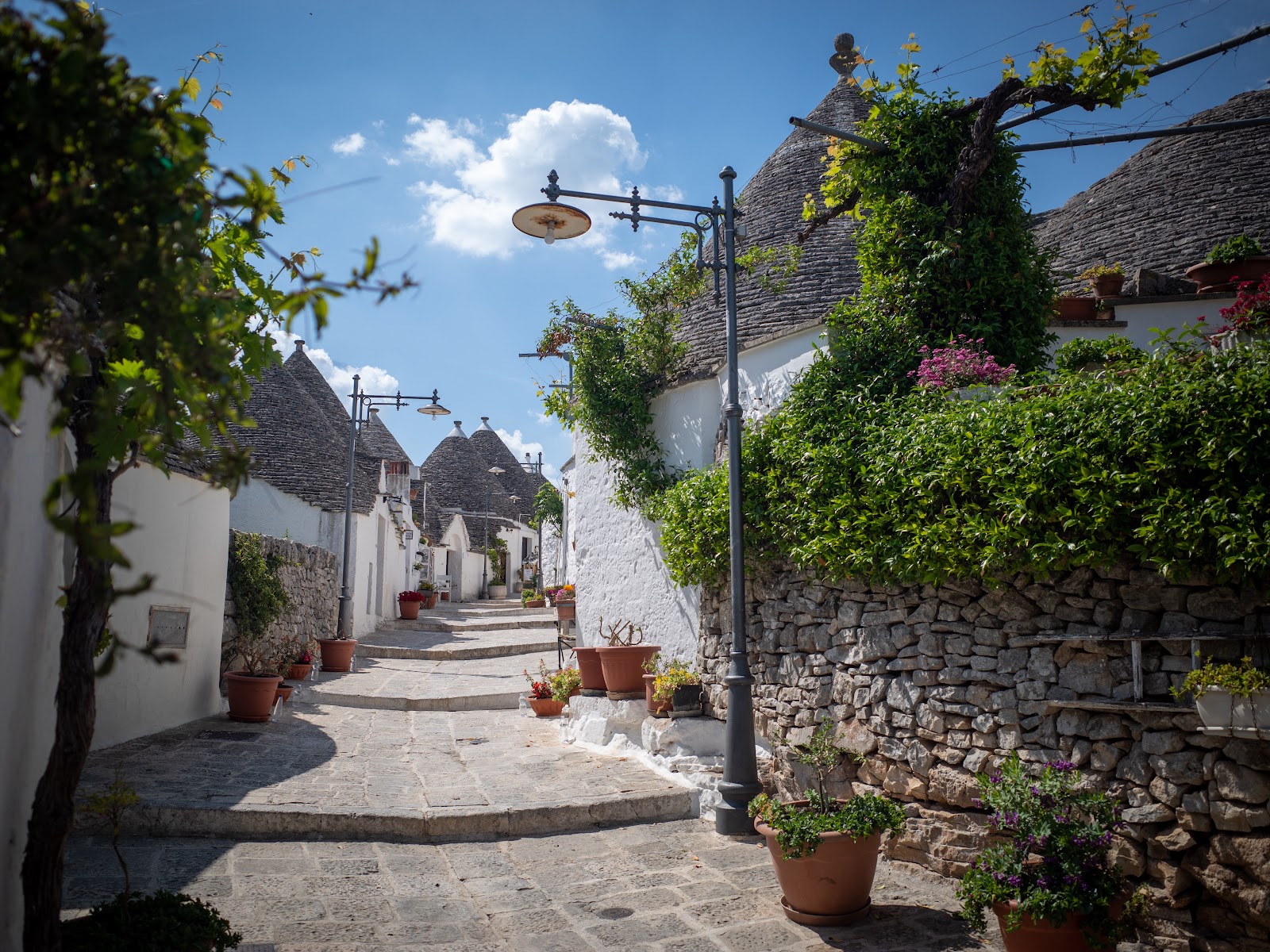

Alberobello is famous for the many trulli it houses in its historical center. Trulli (which is the plural of trullo) are conical shaped houses that are unique to the region of Val d’Itria in Puglia. Alberobello was pretty for an hour-long visit, but it was clearly a touristic place, so we got out pretty quickly. You find trulli everywhere in that region, so it gets old fast (we were staying in one in the farm).
Locorotondo, on the other hand, is a fairly non-touristy, but beautiful town with white buildings and a lot of flowers, and it was a joy to walk around it. I wish I had my drone with me to take an aerial picture of its old town - though I don’t know if that would be legal.
Polignano A Mare is a coastal town with white building on top of cliffs, and a unique and pretty beach in the middle of the old town tall cliffs and buildings around it. It is well worth a visit, or even better, a stay.

Ostuni is probably the most iconic white city (it is called Ostuni The White City), as it is perched atop a hill, and contrast of its white buildings with the green and golden ground and the blue sky makes for a beautiful scenery. I suggest finding a vantage point, and taking a photo of the whole city from outside. Oh, and we randomly found the best gelato ever somewhere outside the old town in Ostuni. The place is called “Ciccio in Piazza”, and they had the best pistachio and hazelnut flavors, along with other fantastic flavors. It was so good that I ordered twice - something I never do with ice cream!
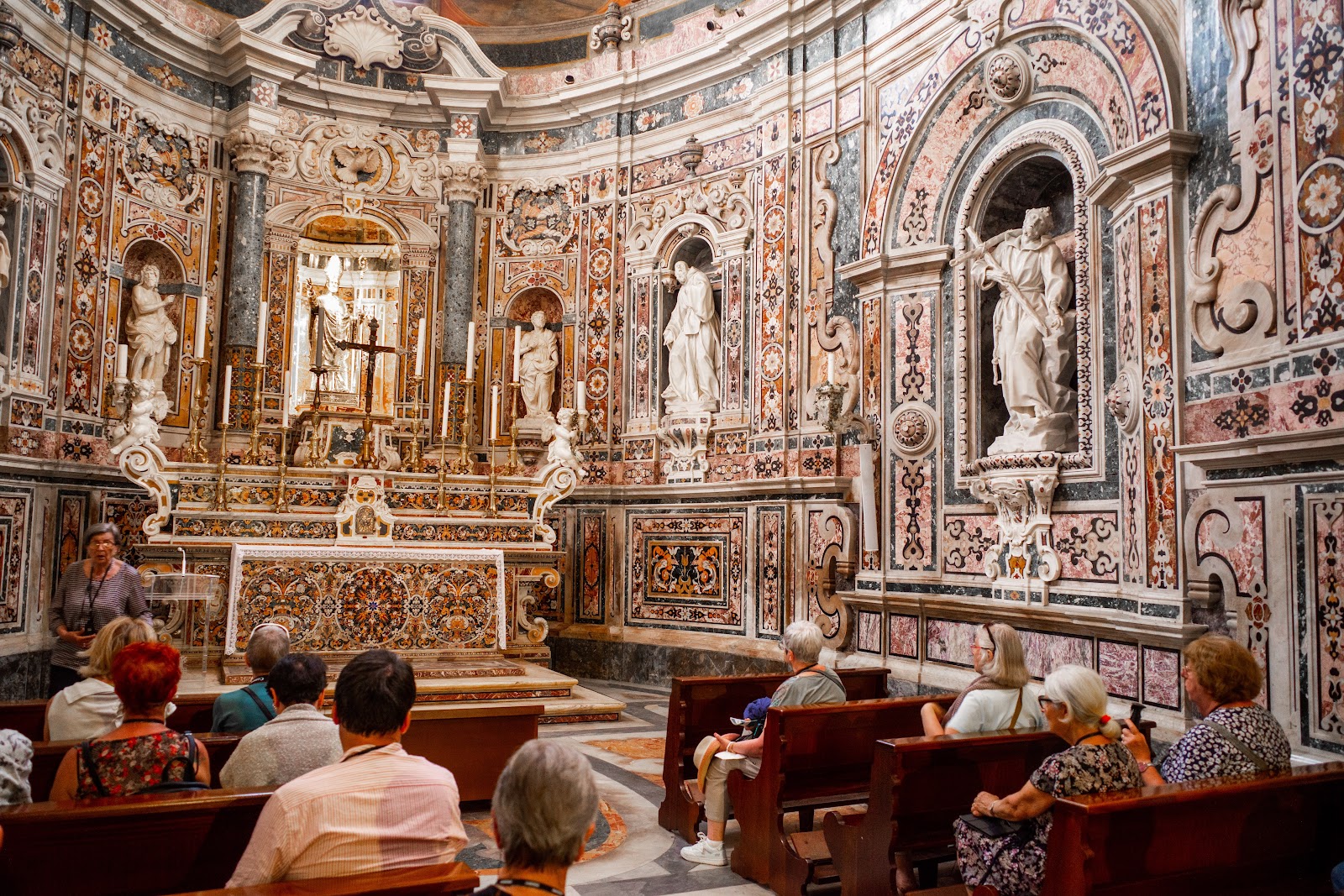
Taranto is a large city (along with Bari and Lecce they make the largest cities in Puglia), and we visited it because I mixed it up with Otranto (my wife was not thrilled when I told her of my mistake), but it turned out to be a good visit. Fun fact: Taranto has actually Greek roots (there are remains of a Greek temple in the old town), and to this day, the people over there have a “Greco accent”. The old town had clearly a rich history, though now it was pretty run-down and dilapidated, testament of a golden past, and a decline in importance afterwards. The cathedral was a good example of how important the city had been in the past, as it featured a chapel with an oval-shaped frescoed ceiling - like a small Sistine Chapel - with walls massively decorated with marble. It was a surprise find, and well worth a visit. We had a hard time finding a restaurant in Taranto old town though on a Sunday noon, as all places seemed to be booked!


After visiting the Val d’Itria region, we moved to Lecce to visit the lower part of Puglia region, called Salento. Lecce is one of the most beautiful cities in Italy, in my opinion, and it is rightly called the Florence of the South - minus the tourists! It is full of baroque-style churches and buildings that are a joy to visit. Pro tips: 1) Get the pass to visit all 4 churches, and do visit all of them, as they are all gorgeously decorated. Also use the phone app to listen to the free audio guide. 2) Spend evenings in the old town, and just wander around, and sample the great food and drinks. Lecce comes to life in the evenings, and it is filled with locals and tourists alike. We spent all of our evenings in Lecce, and immensely enjoyed walking around. There are two Roman amphitheaters unearthed in the middle of the town in early 20th century by chance (though most people only know of one of them, so try to find the other one. Hint: it is tucked in an obscure dead-end alley).
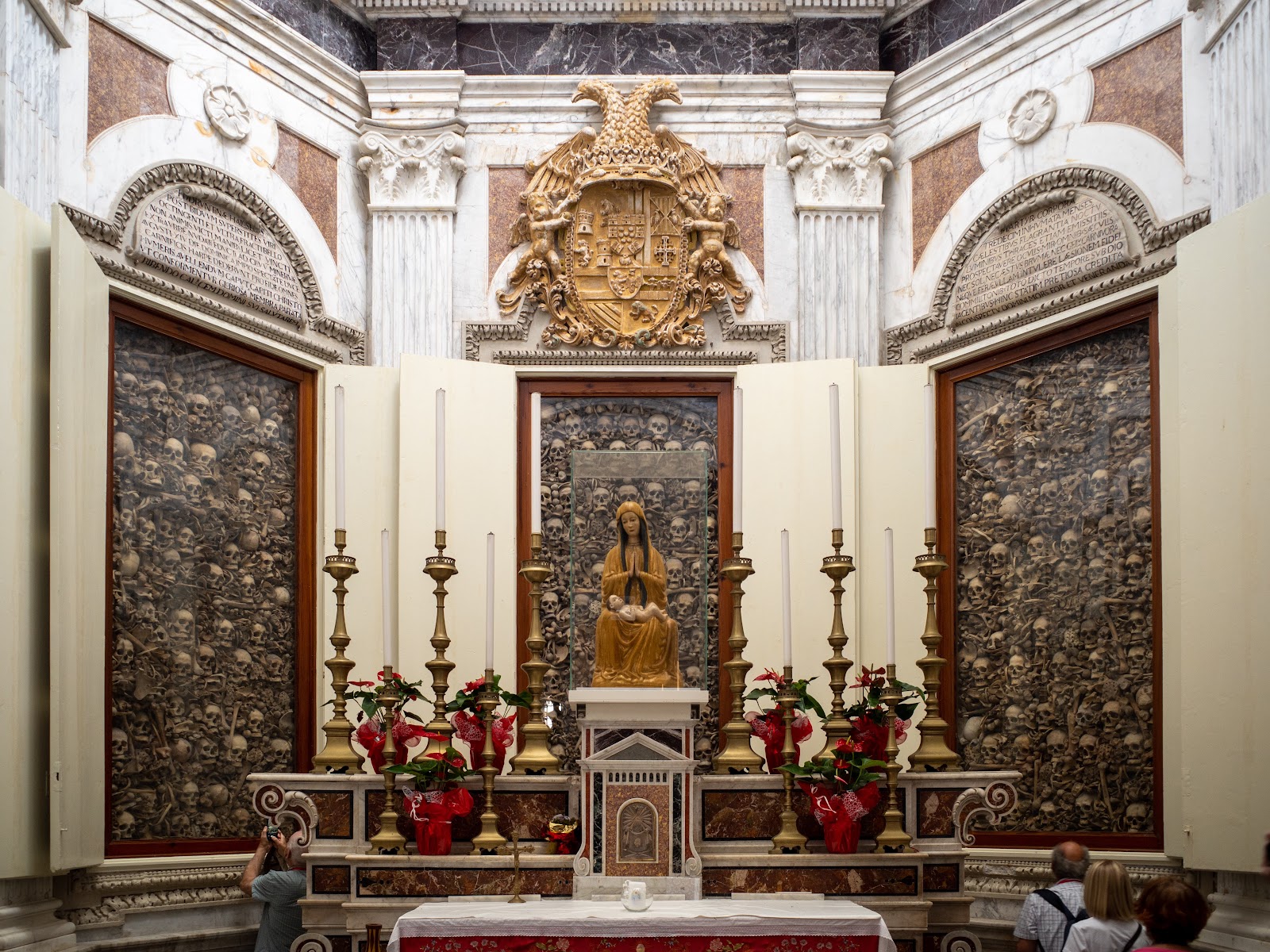
Otranto is a coastal town near Lecce (and the reason we visited Taranto!), and surprisingly has really nice beaches in the town. We went there mostly to visit its famous cathedral that houses the remains of 800 martyrs who were slain during an Ottoman invasion in 1480. Catholic sources say they were martyred because they refused to convert to Islam (though modern historians are not too sure of that claim being the cause of the manslaughter, and they attribute it to taking revenge, and making a lesson, etc). Nevertheless, it was a heinous crime, and the remains of the martyrs can be found encased in a chapel inside the cathedral. Curiously, one of the skulls had many holes on it, which was probably due to the practice of “trepanning”, which was believed to help with releasing pressure after a head injury. The process - apart being painful, and outright useless - had an abysmal survival rate, due to the ensuing infection and errors in the process. All I’m saying is that although we still have a long way to cure many diseases, we should be thankful to the advances in modern medicine!

When visiting Puglia, one activity I suggest is to aimlessly wander and allow yourself to get lost in the maze-like old towns with their white-washed buildings. Most houses are decorated by beautiful flowers on the balconies and entrances, and there are clothes meticulously stretched and arranged on the clotheslines. We loved walking in these neighborhoods, and snapping photos, though I would say the photos don’t do justice in portraying the beauty of these alleyways. Ostuni and Locorotondo were our favorite places to idyllically walk around.
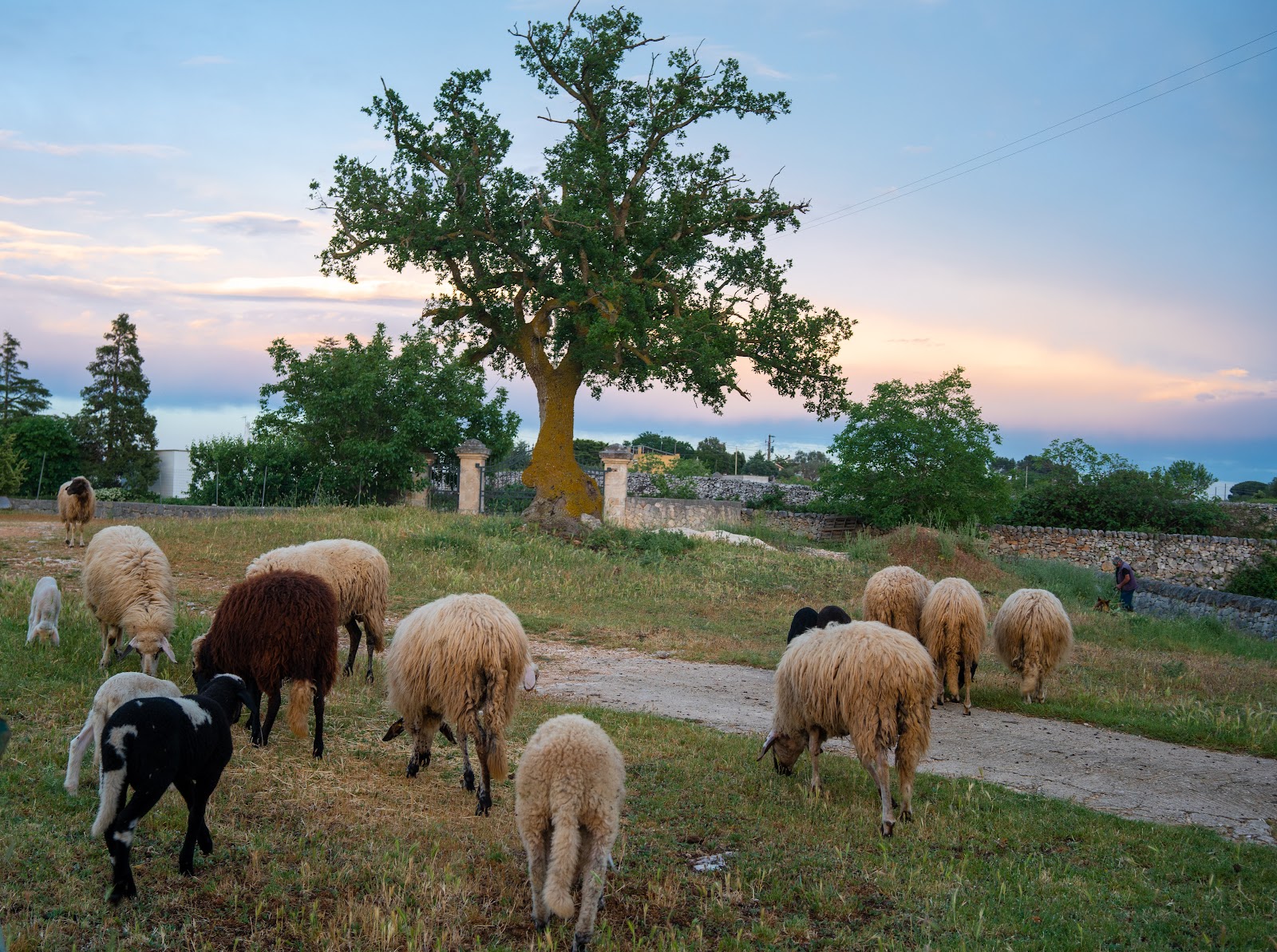
Staying on a farm was a great experience for us, especially since our son loved interacting with and watching the animals. He loved playing with cats and dogs, and visiting the hen pen - that housed a few peacocks as well, for some reason. They even had sheep and goats, and they would make cheese everyday, and generously shared with us their products. We even took a full day off, and stayed only on the farm to relax - as much relax you can get with an active toddler, of course!
Logistics of a trip to Puglia
- It gets pretty hot and humid in summer, and already in May it was sometimes too hot (for me). Most tourists will come in July and August for the beaches, and probably that’s a better time for the beach as the waters will be warmer, but I would avoid that time of year due to the heat, and the flock of tourists (but that’s me).
- You need a car to visit most of the towns and beaches in Puglia. Public transportation in abysmal, and there are just a few trains operating between some cities.
So that was Puglia! We are wrapping up our Italy trip soon, and heading back to Naples to return the car, and fly to our next destination. Since the drive will be long, we are breaking it in two, and visiting some more less-visited, yet fascinating places along the way. Stay tuned!
Per usual, here is a link to my instagram account:
https://www.instagram.com/photopensieve/
Follow me to see the latest photos of the trip. I’ll end the post with an FAQ.

FAQ
How were the beaches in Puglia?
Puglia has amazing beaches with turquoise waters, and offers both rocky and sandy beaches, depending on where you go. One of the more unique beaches is a place called “Calette di Torre Cintola” which is at the site of the remains of a 16th century coastal watchtower. That was a pretty cool place, and it was free! On that note, there are two types of beaches in Puglia: Free, and paid (Lido in Italian). We opted to go the paid places, because for 10-30 euros for two, you got a nice clean beach, with amenities like umbrella, beds, shower (though they are coin-operated), and access to a bar/restaurant. It is of course more economical to bring you own umbrella and bed, and go to a free beach, but we didn’t want to deal with the hassle.
How was the food in Puglia?
Puglia has a rich gastronomic history, so it is no surprise that the food is pretty unique to the region. There are lots of seafood, of course, as well as some local specialties like Bombette, Panzerotti, and pastries like Pasticciotto and Rustico. They even have special pastas like Orecchiette, and Maritati, that I had not seen before. However, I can’t say that in Puglia, we had as delicious produce as we had in Naples region, though that is probably a testament on how good the produce was in Naples rather than the quality of produce in Puglia.
How is the driving like in Italy?
In a nutshell, not so good, but not as bad as some people make it sound like. First of all, the speed limits are more of mere suggestions! The speed limit is 40, for example, and you have to go 80 because another car is ferociously tailgating you. On that topic, something I don’t appreciate at all - and I’m not used to in the US - is tailgating. It’s like the norm here. The car behind you is only 1-2 meters away, even though you’re going way above the speed limit, as you’re afraid they might rear you. Italians are all talking about slow life, slow whatnot, but when they get behind the wheels, they become speed demons! Having said all that, Italy is far from a lawless country, and apart from the tailgating and excessive speed, they respect the law for the most part. There are many other countries in which driving is a nightmare compared to Italy, so I don’t want to frighten people from driving here. Also, my experience is mostly from driving in the south, though if my memory helps, the northern part wasn’t much better either.