Paestum and Matera
After having a fantastic time in the Amalfi Coast, we headed to the Puglia region, which is the heel of the Italy’s boot. It is rather a long drive, especially with a baby, so we decided to break it in two parts by staying a few nights in Matera, which is world-renowned for its cave dwellings. On our way to Matera though, we decided to add another half-day destination: Paestum. This worked perfectly (more on that later), as we had just enough time to visit Paestum, and get to Matera by early evening.

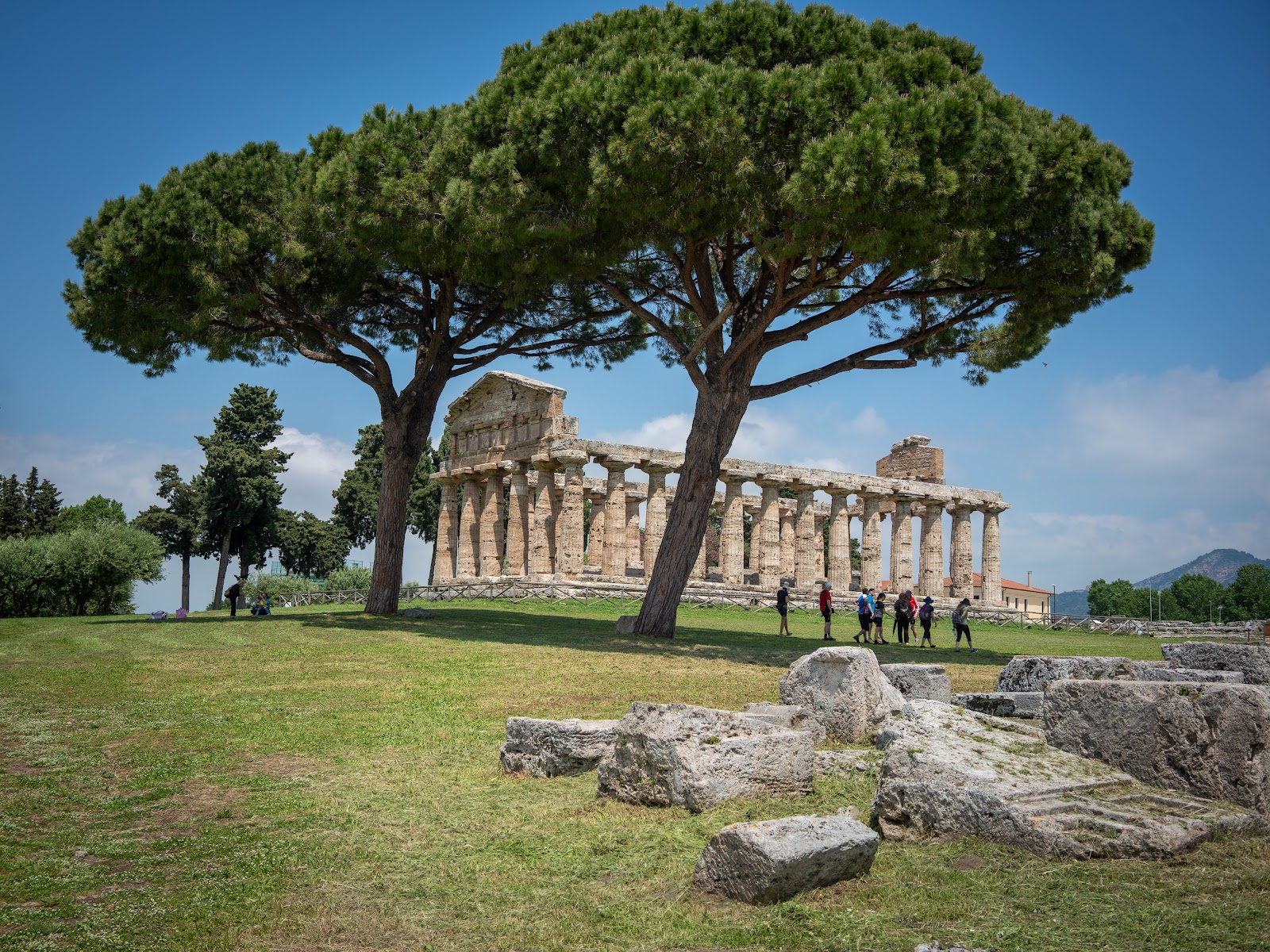
Paestum
Paestum is an ancient city that was founded by Greek settlers around 600 BC (under the name of Poseidonia, after the god Poseidon), and later became a Lucanian and then Roman city until it was abandoned in the early Middle Ages. Paestum is famous for its three large well-preserved Greek temples that are hard to come by outside Greece. In a way, it’s like visiting Greece in Italy! But it’s not all Greek buildings, but you also see remains of a Roman amphitheater, a forum, and some other buildings that are typical of a Roman city. This was so interesting, as it shows how a city evolved under two different cultures over centuries. There are not a lot of written accounts on how the handover took place, but archeology is used effectively to figure out the timing and sequence of events. For example, the excavations of tombs in the area shows two distinct types of tombs belonging to the Greeks and Lucanians (local people who took over). But that of course didn’t mean that the Greeks simply vanished from the region. Instead, they most likely blended in with the new people, producing a fusion of Greek and Italic cultures.

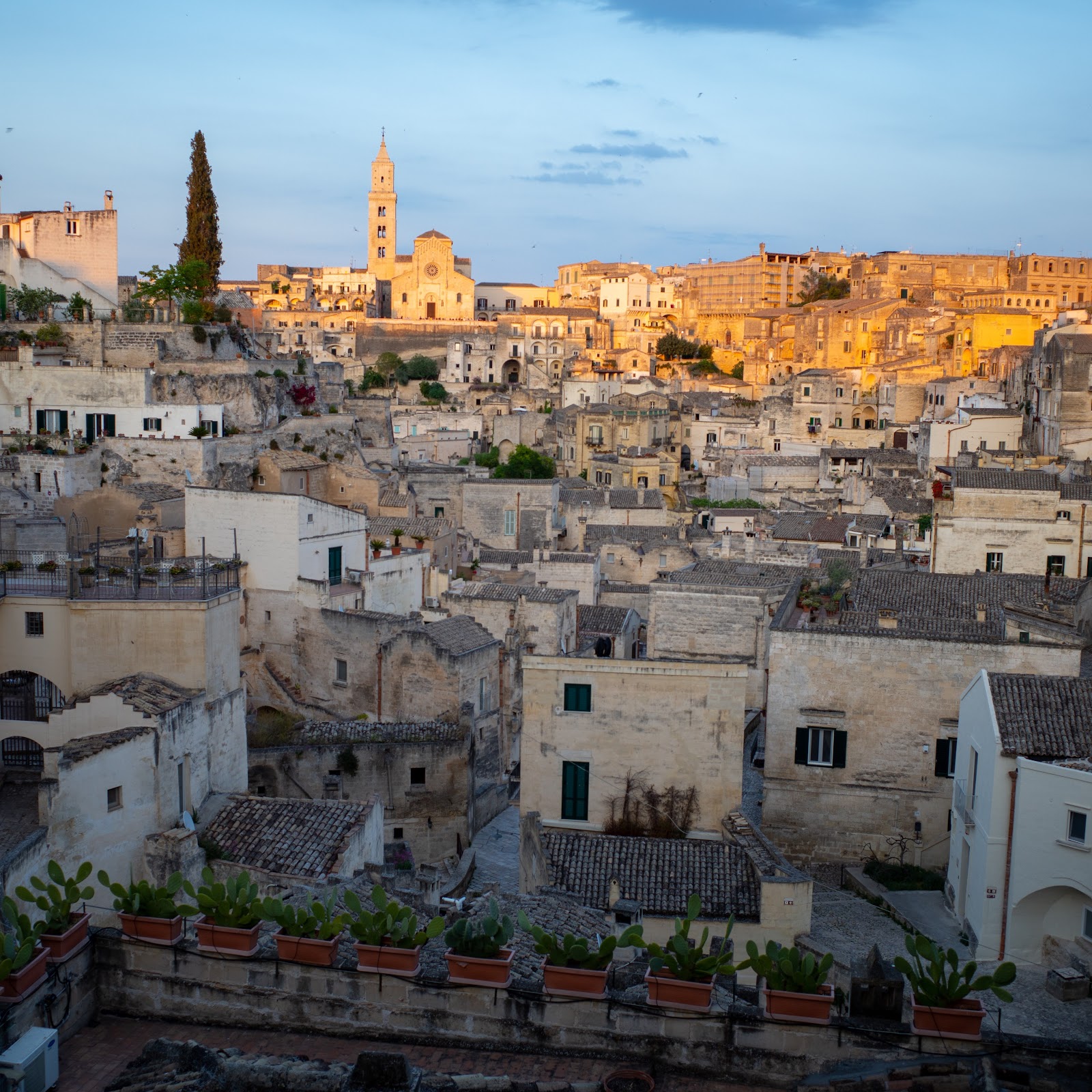
Matera
Matera is a strange and fascinating city, unlike any other I have visited. It is one of the longest inhabited cities in the world, and you literally see a mix of caves, renaissance, and modern buildings all in one place. Given all that, Matera is relatively unknown to the foreign tourists, though it is packed with Italian tourists. Matera is rather newly risen from the ashes as a tourist destination, as it was once called “The Shame Of Italy” in mid-twentieth century. I don’t want to go through all the history, but in order to understand Matera (and the reason it has become rather popular with tourists), we need to first explain the concept of “sassi”. Sassi means stones in Italian, but in Matera, it is used to denote two large ravines where ancient houses were dug out of stone. The two sassis are like two wings dug in the earth separated in the middle by a cathedral, and surrounded by the city of Matera, with a rather lively renaissance-era historical center.

Inside one of the caves that is now transformed into a shop. This is the second chamber, and if you see behind in the middle, it goes down to another cave.
More on the sassis: Almost everywhere in the world, houses are built by putting material on top of each other, and hence creating a positive structure, if you like. But in Matera, since ancient times, people dug the (rather soft) stones repeatedly, and created houses inside the earth, creating a negative structure. Following the same line of thought, when a building gets old, it is demolished, and something else is built on top of it. But in Matera, all you could do was to dig deeper, if you wanted to build something new (or dig elsewhere). That’s why you see cave houses with multiple chambers going into the earth connected to each other. We visited some of these old dwellings, and it was amazing to go down and find the temperature dropping drastically, so much so that on a hot day, the last cave was cold enough to give you goosebumps! But it takes a certain place, and a certain type of people for a place like Matera to happen. Firstly, Matera’s rocks can be easily carved. Secondly, Matera was always off the beaten path during the history. Even Romans didn’t care about it, so there are no Roman remains there. For this reason, Matera was always popular with hermits, monks, asylum seekers, and basically people that didn’t want to be found. The combination of all that made Matera the unique place it is today.
Matera is also a story of a great comeback. As I said before, it was called Shame of Italy after the World War 2. The reason was the extreme lack of hygiene, prevalence of diseases, and lack of access to basic utilities and facilities (like toilet) up until 1950s. Remember I said each cave house was composed of a series of connected caves? Many used the first one as a living space, the second one as an animal house, and the third one as a cellar (not sure why they didn’t flip the order of first and second one?). Imagine everyday bringing in the livestock from your living room to the barn. Not very hygienic. Let alone how water and toilet situation was handled. So in 1950s, the government of Italy evacuated all the inhabitants of the sassis by force, blocked off the cave entrances, and gave the people housing in the modern city of Matera. It wasn’t until 1980s that they revisited the caves, and found a fascinating labyrinth of caves like some 150+ ancient churches with unique frescos, and UNESCO recognized it as a world heritage site. Then came the plan to clean up the sassis, repopulate them, build a lot of hotels and restaurants, and make it a tourist attraction. So in late 1990s or so, they were opened up, and tourists started to slowly trickle in. It wasn’t until it became a Hollywood filming location that it really became popular with tourists (Passion of Christ was filmed there in 2004, for example). That’s called a good business plan! But the flip side of that is the story of the people that were displaced by force, and although it was probably for good, but certainly created a lot of distress.
We stayed in Matera for 3 nights, so we had 2 full days in Matera to explore, and I think it was enough. We also took a guided walking tour, as it was highly recommended, and I think it was a good idea. It was a hot day, and we couldn’t bring the stroller, so I had to carry our son on my back during the tour. Luckily we were mostly in shade, or inside the caves, and he slept all the way through the tour, which was great. Matera is almost doable with a stroller - if you stick to the main routes - but if you want to go into the alleys and into the houses, you better wear the baby. Nightlife was also pretty good in Matera, as the streets of sassis and the old town were teeming with locals and tourists alike (at least during the weekend). It was our first time during this trip to stay out late to see the nightlife, as we generally go back early to put the baby to sleep. But in Matera, we managed to stay out longer (through the magic of adjusting the afternoon nap by planning ahead), and watch the night life. I love how all sorts of people; young and old, singles or families and friends get out at night, and just stroll in the streets in Italy.
As usual, here is a link to my instagram account:
https://www.instagram.com/photopensieve/
Follow me to see the latest photos of the trip. I’ll end the post with the usual FAQ.
FAQ
How is the long-distant driving experience with a one-year-old?
As a general rule, babies don’t like cars, unless they are asleep. If yours loves car rides, you are one lucky person! Babies don’t understand the notion of sitting still (more like strapped still in rear-facing position) for hours on end in order to get to an exciting place - for their parents. We had around 5 hours of driving to get to Matera (could be 4 though if we skipped Paestum, which would have been a shame), so we decided to strategically break it in two parts, so they coincide with our son’s naps. And it worked (almost). We left for Paestum after breakfast and some - when our son typically takes a nap - and he slept the whole two hour drive, which was amazing. We visited Paestum, had lunch, had him play a bit to get tired, and then started the second leg, from Paestum to Matera, which was around 3 hours. He slept for the first two hours, but then he woke up, and he was not happy at all (probably from fatigue, heat, etc). So we had to stop multiple times, and in the end, my wife went to the backseat, and played some of his own videos for him - something he finds extremely interesting. We don’t normally give him any screen time at this age, but when all hell breaks loose, this is our last arrow in the quiver! So with prior planning, and some tricks, we managed to do a 5-hour drive. We will try to keep it more like max 3-4 hours per day from now on.
How is the baby’s sleeping arrangement?
Probably our biggest area of concern before the trip was the sleeping arrangement. As any parent knows, a baby’s sleeping situation is super important, so much so that parents stick to the same routine for their baby’s sleep. Keeping the same routine during a trip is however, nearly impossible, unless you carry your house with you, like traveling with an RV. As I said in the gear list post, we have brought a sleeping tent (KidCo Prestige) for our son, and we got him accustomed to it a couple of weeks before the trip. We’ve also been using baby cribs, whenever they are available (not sure why Airbnb doesn’t allow filtering for places with cribs). For day naps, most of the times we are either driving, or he naps in his stroller while we are outside. In the evenings, we try to keep the same night routine (he like to spend some time on our bed, reading his favorite book, and playing around in a dark room), though we’ve been flexible with the timing. Before the trip, we always stuck with a sleep time (7 to 8 PM), but now if we want to go out late, we adjust his afternoon nap, so he can stay awake longer till 10 PM or so. All in all, this arrangement has worked great so far.