Rome: Going Back in Time

The rich history of Rome has fascinated me for years, so there couldn’t be a better place to start our Eurotrip. I had visited Rome before, but at the time I didn’t dive too deep into the history of Rome. So this time, I decided to briefly study the history of Rome before the visit (and we watched HBO’s series Rome, which is rather accurate, with a pinch of fiction).
One of the places I loved to visit to understand Ancient Rome better was Vatican necropolis. Long time ago, I had heard of it from an Italian friend, who told me it’s like going back to old Rome alleys right under Saint Peter’s Basilica. This sounded all so fascinating but I couldn’t even picture it, so I was determined to visit one day. The necropolis only allows 250 visitors per day, and it should be booked far in advance via faxing the request to the office of excavations at Vatican. They then send you a link by email to pay the fee, and secure an appointment for a guided tour (we were a group of nine). Not sure why you can’t just send an email to book the visit… maybe to deter black market and reselling tickets, not sure. Anyhow, I sent a fax to the excavation office 6 weeks before our departure (had to visit UPS three times to make it work!), and secured a place for the day after our arrival.


So what is a necropolis, you ask? Necropolis is basically a cemetery. In the Ancient Rome, rich families stowed away their dead in sarcophagi (without mummification) or cremated them, and kept the remains in mausoleums. There were other types of burials, like normal graves/tombs, and Egyptian and Christian burial sites, so it was just a mixed religion/culture cemetery, or so it became one as time passed.
According to Catholic tradition, when Romans crucified Saint Peter in the first century (head down on his request), he was buried in a cemetery on current Vatican hill, which at the time was located outside Rome. His burial site quickly became a place of importance for the early Christians, and they soon wanted to be buried around him. In 4th century, when Emperor Constantine declared Christianity as the state religion, he ordered to build a church over Saint Peter’s tomb. Since the burial site was a bit hilly, and there were other mausoleums and burial sites around the place, the architects decided to fill in the whole area with soil, and level it so they could build on top of it. They probably took the remains of Saint Peter out, and kept them in a crypt (more on that later), though we do not know for sure.
That church was operational (though had fallen into disrepair) until 16th century, when the (rich) pope at the time decided to build a magnificent renaissance-style church on top of it (aka, the current basilica) worthy of the status of Catholic Church. Fun fact: Some of the material used in building the current basilica were taken from Colosseum (Romans loved recycling building materials, which explains the current state of ancient ruins).
Basilica was built “on top” of the old church, which parts of it is now in the basement. So there are three levels in Saint Peter’s: On top, we have the current basilica, where you can visit (note the stairs going up to the basilica as you enter). In the middle, we have remains of the old church, and parts of it is open to visit (it’s also where the popes are buried), though you don’t see much of the old church remains. And underneath we have the once entombed necropolis. In 1939, the pope ordered an excavation to find the tomb of Saint Peter, and low and behold, they found it (more on that below). It also resulted in excavating the ancient necropolis, which at the time was filled with soil, and was not known to us.
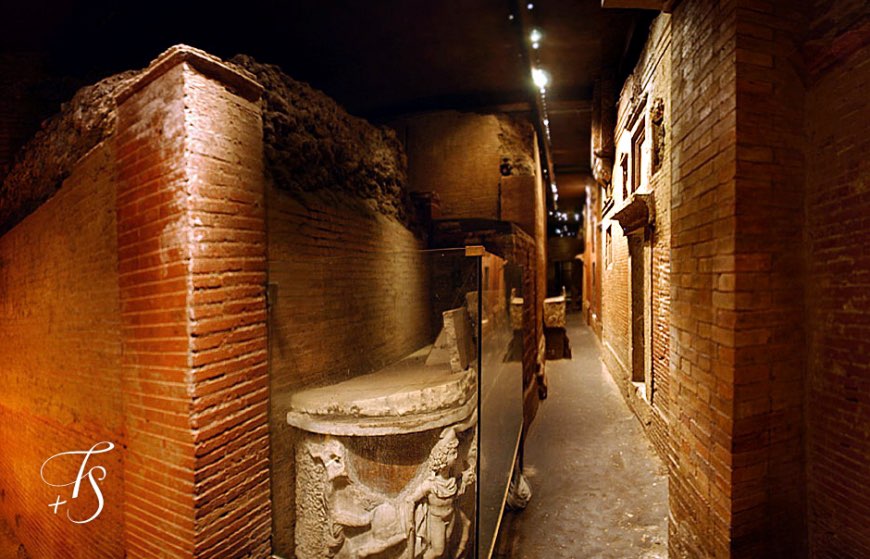
When you go all the way down, you find yourself in an ancient alleyway of the necropolis (or the only one that is excavated). It is formed like a long alley (with a slight slope) with mostly intact mausoleums alongside it, as depicted in the map above. The mausoleums are richly decorated (our guide loved one of them - the one at top of the page - so much so that she said she wants it for her burial site!), and are full of details about the deceased, like carvings of their faces, stories about their lives in stone carvings, and their ages in years, months, days, and even in one case hours. Romans loved to document things for sure!
Fun fact: Pagans used to mark the age on the tomb, whereas Christians (to this day) mark the birth and death dates. The burial site was not just a place to put the dead and forget about them, but apparently much like the ancient Mexican tradition of the Day of the Dead, the Romans used to spend some time there every year, celebrating and sharing their food with their deceased. So it was important that this place was in good shape, and functional (it even had a well that to date was filled with water). Some mausoleums even had stairs in them going to the roof, so the family could sit around on the top floor.
You start the visit from the bottom of the hill (apparent by the high ceiling where you enter), and get out after Saint Peter’s burial site up the hill. We couldn’t get to the original tomb of Saint Peter though, but we could see where it was 10 meters or so away marked by a red light. There was so much history over there, and I learned a lot of interesting facts about Rome and Christianity. If you love history and archeology, I highly recommend visiting the necropolis when in Rome. Just make sure to book in advance! Note that no photography is allowed in there.
The second day, we visited the usual places, walking from Villa Borghese all the way to Trastevere, hitting hotspots such as Trevi Fountain, Spanish Steps, Pantheon, Largo di Torre Argentina (Caesar’s murder site), and Marcello Theater. This was quite a feat, when you consider we were hauling a stroller on cobblestone streets. We didn’t spend too much time in each location, as we had visited most before.
The day after, we rested for the most part, and visited our neighborhood, Garbatella, and did some photography. Garbatella is a relatively new (early 1900s) bohemian-style neighborhood that is for the most part residential (read: no tourist attractions), so it was great to explore on foot, and see the everyday life in a non-touristy part of Rome. In the evening, we went to Colosseum, caught the sunset there, and did some great snaps there. I highly suggest visiting Colosseum around that time as the light and later accent lighting is just perfect.
The fourth and last full day in Rome, we started the day pretty slow: Had caffè latte and pastry from a “bar” for breakfast, then bought bread from a bakery, cheese from a fromagerie, fruit from a greengrocer, all within 20 meters of each other, and made Italian salad for lunch. This is “slow life” in Italy.
In the afternoon, we headed to the Vatican Museum. We preferred going later so the crowds thin, and they did. We were also lucky that with a baby, you get to cut the line altogether, which was great! Finally someone is recognizing all the hardships we new parents go through! Vatican museum is surely larger than I had thought. Consider it more like Louvre in Paris. There were so many amazing pieces of art on display, but our son was clearly not impressed, and got bored soon. Since my wife had already visited the museum before, I went along and did a quick visit of the exhibitions (which took an hour and a half!). I came back for my wife, and we went to the famous Sistine Chapel together and thankfully, our son went to sleep right before it, so we managed to spend some quality time there until they kicked everyone out.
I won’t bore you with the details of what Sistine Chapel is, as there are plenty of good information about it out there. While getting out of the museum, you have the chance to use the double-helix spiral staircase to get down. Many photographers know about it, and have dreamed about capturing that iconic photo. I know I was since the first time I saw the photo of it many years ago.
On our way back, we walked from Vatican to Piazza Navona, and I did some street photography along the way. I am finding my inner photographer little by little!
Here is a link to my Instagram account: https://www.instagram.com/photopensieve/
Follow me to see the latest photos of the trip. I’ll end the post with the usual FAQ.
FAQ
How do we know that the burial site is indeed Saint Peter’s tomb?
Well, it has long been known that Constantine ordered to build the church on the burial site of Saint Peter, but there was no proof that Saint Peter was indeed buried there. When they excavated underneath the St. Peter’s altar in 1940s, they found a group of graves surrounding another grave, showing its importance. There was also some old writing in Greek on the wall that “Peter is here”. But they did not find any remains in the tomb. Apparently, sometime during the Middle Ages, they put the remains in a box, and held it at the higher level, and the forensic analysis showed that the box contained the remains of a 60-70 year old man living in the first century. I guess this is as close as we can get to knowing this.
Why is it so important to find Saint Peter’s tomb down there?
Great question! As far as I understand, Catholic Church was founded based on a verse from Jesus in the bible that “upon this stone I shall build my church”, and stone == Peter in Greek, hence Saint Peter was the first pope of Catholic Church, and Vatican is located where he is buried. So you can imagine that it was kind of important for Catholic Church to prove its founding myth to be true.
Where is the next stop?
We are taking a train to Naples, where we are going to stay for a couple of weeks, exploring the region. There is so much to see around Naples. Stay tuned!
How is the travel with a baby going so far?
The most important question! We were tackling jet lag for the most part, so waking up in the middle of night, and playing (and crying) was to be expected. But apart from that, we were pleasantly surprised that we can cover so much ground with our toddler. So far, he is happy to be carried in a stroller, and even enjoys the bumpy ride! He loves getting out from time to time, and run around, and we try to make sure he is not over-tired. We’ll see how things change when he fully overcomes jet lag.
Is Rome stroller friendly?
Rome is full of cobblestone streets, but I was pleasantly surprised that our stroller (Uppababy Minu) can handle it alright. We have avoided the parts with older and larger cobblestones though, like Roman Forum and Via Appia Antica, as they don’t seem to be manageable with our stroller. All in all, I actually highly recommend bringing a stroller for your toddler when visiting Rome, as it provides shade and a place for nap time, as well as relieving you from carrying your baby and baby gear on long walks. Note that metro stations and some attractions (like Vatican Museum) do not always have elevators, and you might have to carry your stroller up and down stairs quite a bit. So bring a lightweight, yet sturdy and foldable stroller with you.
What are your top three places in Rome?
1) Colosseum, 2) Roman Forum, and 3) Vatican. We still haven’t explored half of what Rome has to offer though, so we will be returning back.
How is photography going?
As I said in the last post before the trip, I was not sure what to bring with me, so I brought along two cameras: Sony A7R II with three small prime lenses, and the Ricoh GR III. I take the GR when we go for walks, or when I don’t have a specific photo shoot in mind. It works perfectly well, as it is a super compact camera that weighs close to nothing. I bring the Sony with me when I expect to do more serious photography, e.g. when we went to Colosseum for sunset, or to the Vatican Museum for shooting the spiral stairs.